
GST on Amazon Seller Fees in Australia: Which Ones Carry It, and Who Gets It Back (2026)
Part of the guide: The money · Amazon FBA
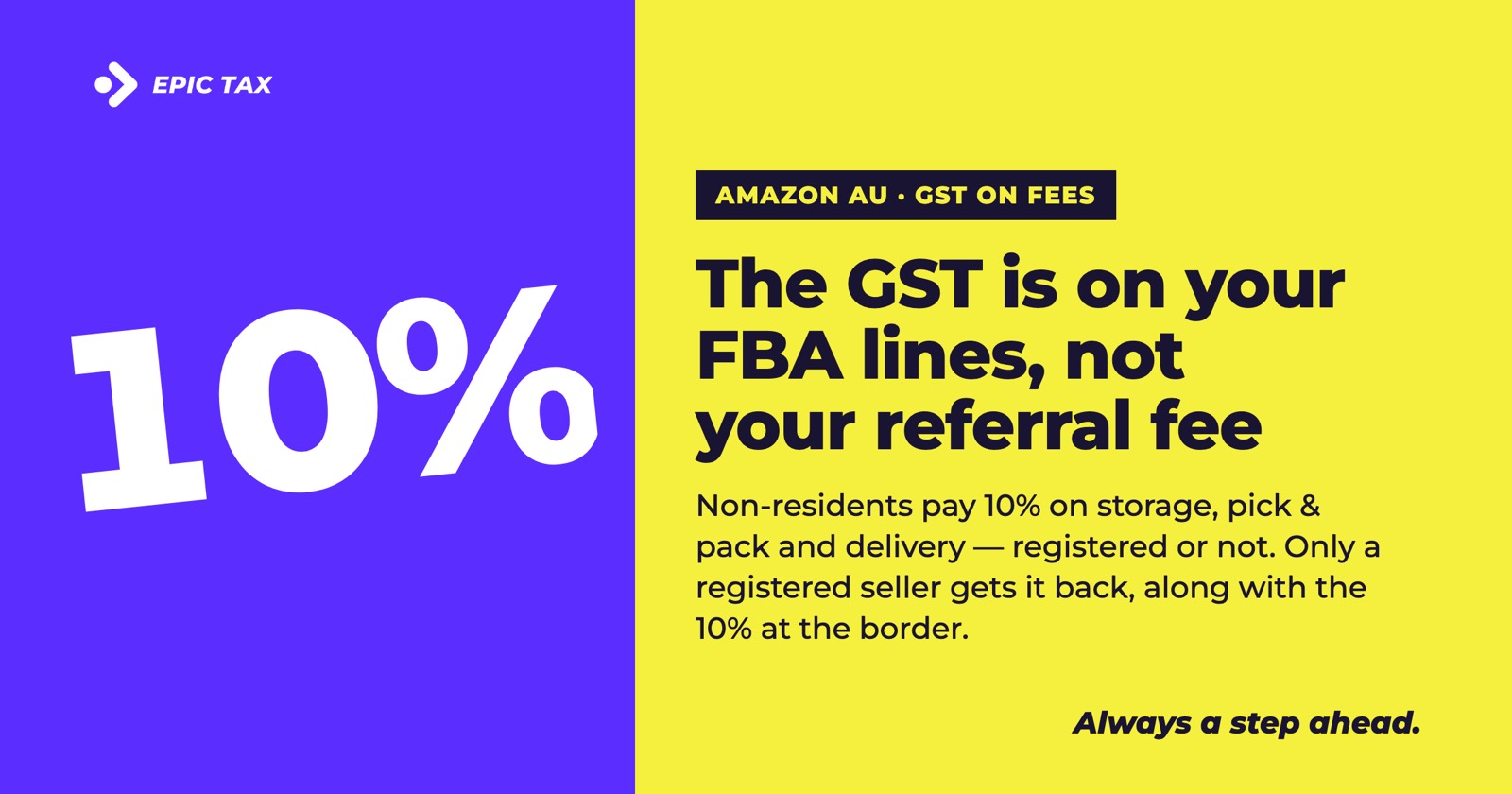
There is a piece of advice doing the rounds for overseas sellers on amazon.com.au: “register for GST and claim back the 10% on your Amazon fees.”
It is half right, and the wrong half wastes months. The GST is not on your referral fee, your subscription or your advertising — for a non-resident those lines were never charged it. It is on your FBA lines — storage, pick & pack, shipping — every month, whether or not you are registered. And the only way to get that 10% back is the same registration that unlocks the far bigger 10% you pay at the border on your stock.
Here is the whole picture in one table, and then the detail behind each line.
| Who you are | Platform fees (referral, subscription, advertising) | FBA fees (storage, pick & pack, shipping) |
|---|---|---|
| Australian seller, no GST-registered ABN on file | 10% added — a 15% referral fee behaves like 16.5% | 10% added |
| Australian seller, GST-registered ABN on file | Generally not charged; where charged, claimable | 10% added, claimable |
| Non-resident, not registered | No GST — nothing to claim | 10% added — not recoverable |
| Non-resident, registered | No GST — nothing to claim | 10% added, claimable on your BAS |
(General information, not tax advice. FY 2026–27 settings. The split above is what Amazon’s fee invoices to non-resident sellers actually show; your own invoices govern what you were charged.)
1. Is there GST on Amazon seller fees in Australia?
Yes — added on top of the advertised number, never included in it, and which lines carry it depends on who you are. Amazon publishes its Australian selling fees exclusive of GST. As at 7 September 2026, its published pricing shows:
- Professional selling plan: A$49.95 per month (excl. GST)
- Individual plan: A$0.99 per unit sold (excl. GST)
- Referral fees: 6%–15% depending on category — most general merchandise sits at the upper end
- A$1.00 closing fee per media item sold
- FBA fees — storage, pick & pack, shipping — set per size tier, also quoted excl. GST
Because those are GST-exclusive prices, a seller who is charged GST pays another 10% on each one. A 15% referral fee is not 15% to that seller — it is 16.5%. On A$200,000 of sales, the referral fees are A$30,000 and the GST loaded on top is A$3,000 a year.
Australian-based sellers who have not given Amazon an ABN that Amazon’s check confirms is registered for GST are charged it across the board. Amazon has charged GST on “Selling on Amazon” fees to Australian-based sellers since 1 July 2017, and it is not enough to type an ABN into Seller Central — the ABN has to come back as GST-registered. Once it does, the platform-side fee GST generally stops being charged, and any GST that is charged comes back as a credit on your BAS.
For a non-resident seller the answer splits by fee type — and that split is the rest of this article.
2. Does Amazon charge GST on my seller fees if I’m a non-resident?
On your FBA fees, yes. On your platform fees, no. Read a non-resident’s monthly fee invoice from Amazon Commercial Services Pty Ltd and you will see it line by line:
| Fee line | GST to a non-resident? |
|---|---|
| Referral / seller fees | No |
| Professional subscription | No |
| Advertising | No |
| FBA Inventory Storage | 10% |
| FBA Pick & Pack | 10% |
| Shipping Chargeback (delivery) | 10% |
| Prep, labelling and other FBA services | 10% |
One real month from one non-resident client: A$398.03 of FBA and shipping fees carried A$39.74 of GST. Every FBA line, 10%. The advertising line, nothing.
Why the split. A service supplied to a business outside Australia is normally GST-free as an export of services (section 38-190(1) item 2 of the GST Act). Referral, subscription and advertising flow to you and nobody else, so that rule holds and they stay GST-free. FBA is different in one decisive way: Amazon is storing, picking, packing and delivering your goods to a buyer in Australia. The ATO treats delivery of goods addressed to another entity as a service provided to that addressee (GSTR 2025/1 ¶72) — and where a supply made to a non-resident is provided to another entity in Australia, section 38-190(3) switches the GST-free status off. The fulfilment service is contractually yours, but its actual flow is to the Australian buyer, so it comes back inside the GST net.
Registration does not change whether it is charged. Section 38-190(3) turns on who receives the service, not on whether you hold an ABN. The 10% is on your FBA lines before you register and after. What registration changes is whether that 10% comes back to you.
So the street advice needs correcting in both directions. “Claim back the GST on your Amazon fees” is wrong about the referral fee — there is nothing there — and right about FBA, with a catch nobody mentions: you can only claim it once you are registered, and never for the months before.
One edge worth knowing: where Amazon simply moves your own goods without delivering them to anyone — a removal order back to you, a transfer between fulfilment centres — that is not “provided to another entity”, and those lines can sit outside the GST charge. Check the line.
3. Do Amazon purchases have GST?
It depends on who sold the item and where it shipped from — not on the fact that you bought it on Amazon. There are three common cases on amazon.com.au:
- Sold by Amazon’s own Australian entity. GST applies, and a tax invoice is available in Your Orders.
- Sold by a third-party marketplace seller, shipped from within Australia. GST applies only if that seller is registered for GST. Plenty of small sellers are not, and a seller who isn’t registered cannot charge GST and cannot issue a tax invoice.
- Shipped from overseas, customs value A$1,000 or less. GST is added at checkout — but by Amazon as the platform, not by the seller. Under the low value imported goods rules that started on 1 July 2018, the platform collects the 10% and remits it to the ATO. On the customs documentation you will see the ABN of the entity collecting it: Amazon Commercial Services Pty Ltd, ABN 30 616 935 623.
And one case that surprises people: shipped from overseas with a customs value above A$1,000. Nothing is added at checkout at all. That does not mean the goods are GST-free — it means the GST is collected at the border instead, along with any customs duty, when the goods are imported.
4. Why is there no GST on my Amazon order?
Almost always one of four reasons, and only one of them means no GST was ever payable.
- The goods came from overseas and the customs value was over A$1,000. GST is collected at the border on import, not at checkout. You have not saved 10%; you will meet it at customs.
- The third-party seller is not registered for GST. No registration, no GST charged, no tax invoice, and nothing for a business buyer to claim.
- The item is GST-free. Basic food, most medical aids and appliances and some health goods carry no GST anywhere in the chain. This is the one case where there is genuinely no GST.
- You are looking at a receipt, not a tax invoice. The GST may well have been charged; the document just isn’t the one that shows it. Tax invoices for Amazon-sold items are in Your Orders; for marketplace items, request one from the seller.
If you are a business buyer, only reasons 1 and 4 leave you with something recoverable — and for reason 1, it is recoverable at the border, not from Amazon.
5. Can I claim the GST on an Amazon purchase or an Amazon fee?
Only if GST was actually charged, the purchase was for your business, and you were registered when it happened. All four of these have to be true:
- You are registered for GST. Not “have an ABN” — registered. Registration is generally required once your GST turnover reaches A$75,000 (you may need to register at that point, and you have 21 days from crossing it or reasonably expecting to), and you can register voluntarily below it.
- The supply was actually taxable. Your FBA lines were — claim them. Your referral and advertising lines were not — coding a nil-GST line as “GST on expenses” doesn’t create a credit, it creates an error on your BAS.
- You hold a valid tax invoice for any purchase over A$82.50 (GST-inclusive). Amazon’s monthly fee invoice is that document for your fees.
- You are within four years of the due date of the BAS in which the credit could first have been claimed.
Get all four and the credit returns the 10% itself through your BAS. Worth being precise here, because the two get muddled constantly: a GST credit gives you back the whole 10%. An income tax deduction is a different animal — it reduces your taxable income, so it saves you the cost multiplied by your tax rate, never the cost itself.
6. So what does a non-resident Amazon seller actually get back?
Two layers — and both of them only after registration.
Layer one: the 10% on every FBA line. At A$39.74 on a quiet A$398 month, that is small. At scale it is not: an FBA bill of A$4,000 a month is A$400 of GST a month, A$4,800 a year, that an unregistered seller simply pays and a registered seller gets back.
Layer two: the import GST on your stock. When your goods are imported, GST of 10% is payable on the taxable importation value — customs value + any customs duty + international transport and insurance. On A$100,000 of landed stock that is over A$10,000, on every cycle. A registered seller importing for their enterprise recovers it through the BAS. An unregistered seller does not.
Both layers share the same hard edge: nothing before your registration date is recoverable. Not the FBA GST on last quarter’s invoices, not the import GST on the container that landed in March. Every month unregistered is a month of both layers gone for good — and that, not the referral fee, is the whole case for getting registered before the next container ships.
And yes: a non-resident FBA seller can hold an ABN and register for GST. The entitlement comes from making supplies connected with Australia — stock sitting in an Australian warehouse, sold to Australian buyers — not from “carrying on an enterprise in Australia”, which is the test people wrongly assume shuts them out.
Where to go from here
You can do this yourself, and it costs nothing to lodge. The ATO does not charge a fee for an ABN or a GST registration, the forms are online, and a straightforward application can be approved quickly. If your affairs are simple and you have the identity documents ready, go and lodge it.
Where an agent earns the fee is everything around that form. A non-resident application refused for the wrong entitlement reason, or lodged with identity documents certified the wrong way, does not come back with a helpful note — it comes back months later, and in the meantime every FBA invoice and every container carries GST you will never see again. Getting the entitlement basis, the registration date and the BAS cycle right the first time is usually worth more than the whole engagement costs, and it is worth more the earlier it happens.
If you want a second pair of eyes on your fee invoices — which lines carry GST, what you have already paid that you can’t recover, and what registration would return from here — that is a short conversation, not a project.
General information only, current for the 2026–27 financial year — not tax advice, and not a substitute for advice on your own circumstances. Amazon’s fee arrangements change without notice; your own fee schedule and invoices govern what you were charged. Epic Tax is a registered tax agent.
Common questions
Is there GST on Amazon seller fees in Australia?
Yes, added on top of the advertised fee, and which lines carry it depends on who you are. Amazon publishes its Australian fees exclusive of GST. An Australian seller without an ABN that Amazon confirms is GST-registered is charged 10% on everything, so a 15% referral fee behaves like 16.5%. A non-resident seller pays no GST on referral, subscription or advertising fees, but pays 10% on FBA storage, pick and pack and shipping.
Does Amazon charge GST on seller fees to non-resident sellers?
On FBA fees, yes; on platform fees, no. Referral, subscription and advertising are supplied to the non-resident alone and are GST-free as an export of services under section 38-190(1) item 2 of the GST Act. FBA storage, pick and pack and shipping carry 10% GST whether or not the seller is registered, because Amazon is delivering the goods to a buyer in Australia and the ATO treats that service as provided to the buyer, which section 38-190(3) brings back inside the GST net (GSTR 2025/1 paragraph 72).
Does registering for GST change whether Amazon charges GST on my FBA fees?
No. Section 38-190(3) turns on who receives the service, not on whether the seller holds an ABN, so the 10% is on FBA lines before and after registration. Registration changes one thing: a registered seller claims that GST back as an input tax credit on the BAS, while an unregistered seller simply pays it.
Why is there no GST on my Amazon order?
Usually one of four reasons: the goods came from overseas with a customs value above A$1,000, so GST is collected at the border instead of at checkout; the third-party seller is not registered for GST; the item is GST-free, such as basic food or medical aids; or the document is a receipt rather than a tax invoice.
Can I claim GST on an Amazon purchase or fee?
Only if GST was actually charged, you are registered for GST, the purchase was for your enterprise, you hold a valid tax invoice for anything over A$82.50 GST-inclusive, and you claim within four years of the due date of the BAS in which the credit could first have been claimed. FBA fee lines qualify; referral and advertising lines carry no GST and give no credit.
What can a non-resident Amazon FBA seller actually claim back?
Two layers, both only from the GST registration date onward: the 10% GST on every FBA fee line, and the 10% import GST paid at the border on stock, calculated on customs value plus any duty plus international transport and insurance, which is over A$10,000 per A$100,000 of landed stock. Nothing charged before the registration date can be recovered.
Does this apply to you?
Book a free consultation — your situation, your options, and a fixed-fee quote within one business day.