
Does eBay Collect GST on My Australian Sales? The A$1,000 Rule, and the Warehouse That Changes It (2026)
Part of the guide: Do I need to register?
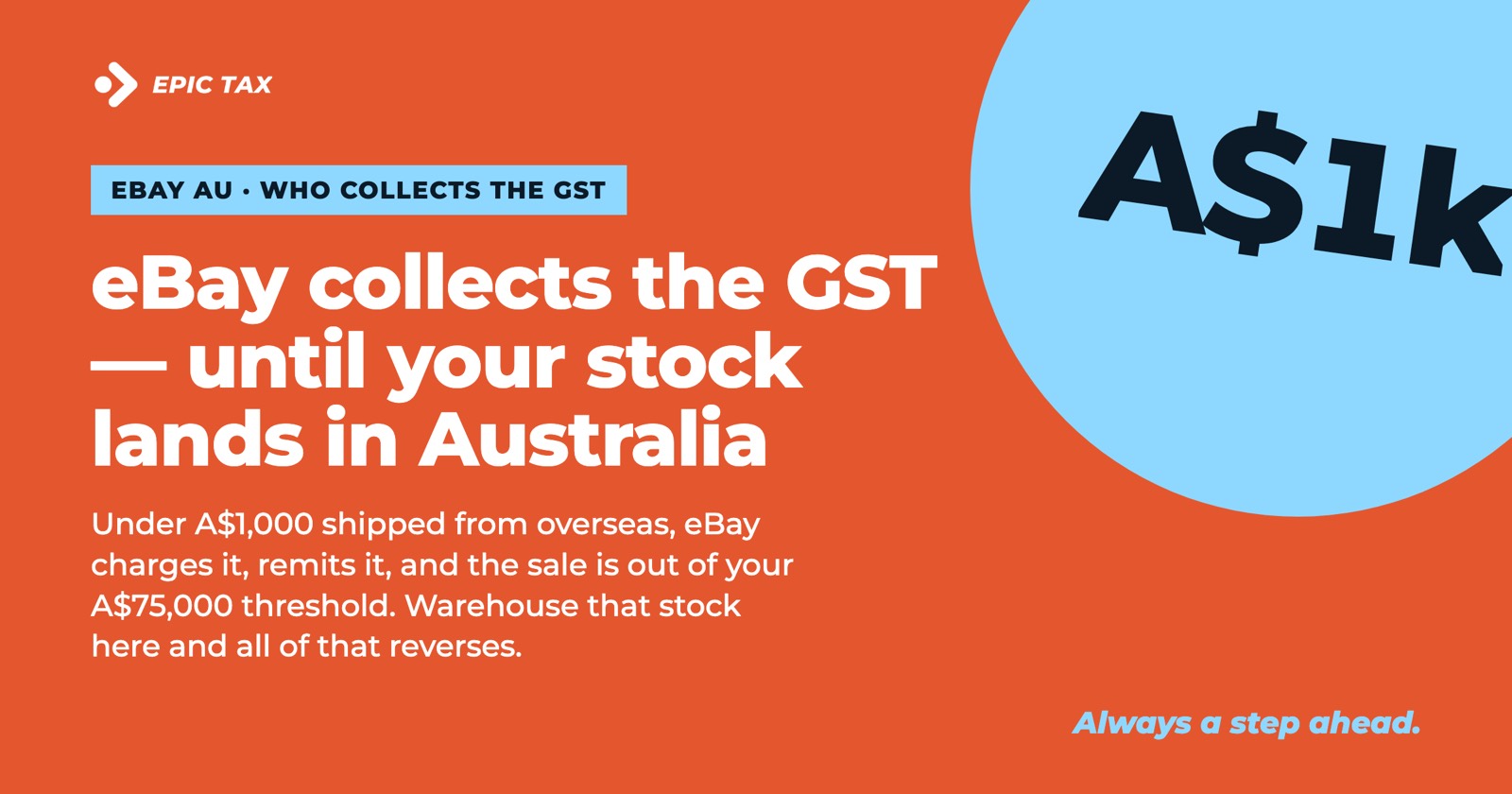
Yes — on most of them, and that is better news than it sounds.
If you ship to Australian buyers from overseas and the goods are worth A$1,000 or less, eBay charges the GST at checkout, remits it to the ATO, and — this is the part almost nobody mentions — the ATO takes those sales out of your own GST turnover. A seller doing A$300,000 a year entirely that way may still sit below the A$75,000 registration threshold and have nothing to lodge.
There is one fact that reverses all of it, and it has nothing to do with where you live: where the goods were sitting at the moment of sale. Put your stock in an Australian warehouse and eBay stops being the supplier, the GST obligation lands on you, and the fast registration option closes off.
Here is the whole thing in one table.
| Where the goods were when sold | Who owes the GST | Counts towards your A$75,000? |
|---|---|---|
| Overseas, customs value A$1,000 or less, sold to an Australian consumer | eBay, as the platform | No |
| Overseas, consignment customs value over A$1,000 | Nobody at checkout — the importer pays at the border | No |
| Already in an Australian warehouse | You | Yes |
(General information for FY 2026–27, not tax advice for your circumstances. Thresholds and registration rules confirmed against the ATO on 8 September 2026.)
1. Does eBay charge GST in Australia — or do I?
eBay does, on sales of low value imported goods to Australian consumers — and where eBay is responsible, you neither charge the GST nor report it. (The rule itself — the customs-value test, the LCR 2018/1 exception and the customs paperwork — is set out in GST on low value imported goods: how the A$1,000 rule works for sellers.)
The mechanism is a rule about electronic distribution platforms (EDPs). The ATO defines an EDP as a service delivered by electronic communication that merchants use to make sales to customers — a website, an online marketplace, an app store. eBay is squarely one. A service is not an EDP if all it does is carry data, process payments, or run advertising that links buyers to your own website; in those cases the sale stays yours.
Where the platform is responsible, the ATO treats it as the supplier. eBay’s own tax policy says it plainly: it is “required to collect GST on orders up to AU $1,000 imported into Australia”, and it “remits the GST amount to the Australian Taxation Office (ATO)”.
The ATO’s worked example makes the consequence concrete. A platform sells a A$77 product from an overseas merchant to an Australian consumer. The platform returns the A$7 of GST in its own return, and the merchant does not return GST on the sale and does not count it when working out whether it has to register.
So on a straightforward overseas-to-Australia eBay sale under A$1,000, your GST job is: nothing.
One caveat worth knowing rather than acting on: a platform and a merchant can agree in writing to shift responsibility back to the merchant, but only where the customer’s document names the merchant as the supplier and the platform controls none of the charge, the delivery or the terms. That is not how a mainstream marketplace operates. Assume the platform is responsible unless something in writing says otherwise. The detail is in LCR 2018/2.
2. When exactly is eBay charging GST on an Australian sale?
When the customs value is A$1,000 or less, tested at the moment the price is first agreed with the buyer. Two things about that sentence trip people up.
Customs value is not the price your buyer pays. The ATO defines it as “the price the goods are sold for, minus freight and insurance from the place of export” — the goods alone. But once an item qualifies, GST is charged on the whole delivered price. The ATO’s own example: jeans with a customs value of A$300, sold for A$350 including shipping and insurance, and GST charged on the full A$350. Customs value decides whether GST is collected at checkout; the total price decides how much.
Above A$1,000, nothing is collected at checkout at all. GST, customs duty and clearance charges are billed to the importer at the border instead. Different collection point, different payer, different paperwork — but the 10% is still paid.
And the exception that catches sellers with cheap, bulky lines:
Several low value goods shipped to Australia as one consignment with a total customs value over A$1,000 are taxed at the border, not at checkout.
The ATO’s illustration is two A$750 necklaces. Sent separately, GST is charged on each sale. Sent in one package — A$1,400 of customs value — nothing is charged at checkout and the buyer meets it at the border. If you consolidate orders to save on freight, you may be quietly moving sales from one regime to the other, and your buyer is the one who finds out.
Alcohol and tobacco sit outside this framework entirely and are taxed at the border regardless of value.
3. Is there GST on eBay if my stock already sits in an Australian warehouse?
No — and this is the flip that catches sellers moving to local fulfilment. Once the goods are in Australia when they sell, the platform is not the supplier, and the GST obligation is yours.
The ATO could not be more direct about it:
“A non-resident business that imports goods and warehouses them in Australia prior to selling them online, directly or through an electronic distribution platform, will have a GST obligation for the goods sold because the goods are located in Australia.”
And in its worked example of exactly this arrangement — a Hong Kong seller warehousing stock with the marketplace that sells it — the ATO adds:
“[The platform], as an electronic distribution platform operator, is not treated as the supplier for GST purposes because the goods are located in Australia at the time of the sale.”
Nothing about your residency changed. Nothing about the buyer changed. You moved a pallet, and three things moved with it:
- The 10% is now yours to charge and remit. These are ordinary domestic taxable supplies.
- These sales now count towards the A$75,000 threshold — because the exclusion in section 4 below only applies where the platform is responsible.
- Simplified GST registration is no longer available to you. The ATO states this explicitly for warehoused stock. You need standard registration.
That third point is the expensive one, and it is covered in section 5.
There is also a wrinkle on the way in. Bringing a bulk shipment into Australia is itself a taxable importation: 10% of the customs value plus duty plus international transport and insurance, paid at the border. On A$100,000 of landed stock that is over A$10,000. Registered under the standard system, that is a credit you claim back. Unregistered, or registered under the simplified system, it is a cost you keep.
4. Do you pay GST on eBay purchases in Australia — and what does that do to my payout and my threshold?
Your Australian buyer pays 10% either way — but where eBay collects it, the money never belongs to you, and the sale never enters your GST turnover.
From the buyer’s side the receipt looks the same whoever collected it. From your side there are two very different outcomes.
Your payout. Where eBay is the supplier, the GST is eBay’s to collect and eBay’s to remit. It is not revenue you are holding on the ATO’s behalf and it should not appear in your accounts as though it were. Where the obligation is yours, the opposite is true: one-eleventh of every GST-inclusive sale is money you are holding for the ATO, and eBay’s listing rules give you no way to add it after the fact. eBay requires that “your prices must include GST, when applicable” and that “you may not add GST to the final value of an item once it has been won or bought.” A seller who becomes liable mid-year and does not reprice is not collecting extra GST from buyers — they are carving 10% out of margin they already had.
Your threshold — the part worth reading twice. The ATO says it in the merchant guidance:
“If the EDP operator is responsible for GST, these sales don’t count towards your GST turnover when calculating if you need to register.”
That is the relief. Your GST turnover counts sales connected with Australia — imported services and digital products to Australian consumers, and low value imported goods to consumers. Platform sales where the platform carries the obligation come out. You may register voluntarily, but you may simply not have to.
Three qualifications, and they matter:
- Your own store stands alone. If you sell through eBay and a Shopify site, the eBay sales are excluded but the store sales are not — and A$75,000 of store sales on its own may require you to register.
- Warehoused stock counts. Anything from section 3 goes back into turnover.
- Registered business customers come out. Sales of low value imported goods, imported services and digital products to Australian businesses that are registered for GST are excluded from your turnover. Confirm the customer’s ABN and GST registration on ABN Lookup — don’t take it on trust.
The test runs both backwards and forwards: your current turnover (this month plus the previous eleven) or your projected turnover (this month plus the next eleven). Either one reaching A$75,000 may require registration, and the ATO expects it within 21 days of crossing, or of reasonably expecting to cross. The threshold is not indexed, so check the current figure before you rely on it.
5. Does eBay Australia charge GST on my seller fees?
If your registered address is in Australia, yes — 10% on your fees, unless you have lodged a valid ABN and confirmed you are registered for GST. If you are outside Australia, eBay’s own pages say your local GST or VAT may apply instead. Read your fee invoice.
For an Australian seller the fix is administrative and worth doing on day one: lodge the ABN, confirm GST registration, and eBay applies the exemption. Without it, 10% rides on top of every fee. Where you are registered and GST is charged anyway, it is a credit on your BAS — but only against a valid tax invoice, and only for purchases above A$82.50 GST-inclusive is that invoice mandatory. You have four years to claim. The fee-by-fee breakdown, with the divide-by-11 maths, is in GST on eBay fees in Australia.
For a non-resident seller, be careful here, because there is a wrong lesson circulating.
An eBay selling fee is a platform service supplied to you, offshore. That is a different transaction from an Amazon FBA fulfilment fee, where Amazon picks, packs and delivers your goods to a buyer in Australia — the ATO treats that service as provided to the Australian buyer, which pulls it inside the GST net and puts 10% on it whether or not you are registered. We wrote that up separately, and it is a real difference in the underlying facts, not a difference in platform policy. Do not carry the Amazon answer across to eBay, and do not carry the eBay answer back.
What we can say about eBay is what eBay says: for a seller living outside Australia, local consumption tax may apply in place of Australian GST. Your own fee invoice is the authority on what you were actually charged. If you use a third-party Australian warehouse or 3PL, its fees are a separate question again — those services are performed on goods in Australia and will generally carry GST.
What to do next
If you ship from overseas, everything under A$1,000, and sell only through eBay, there may be genuinely nothing to do. Confirm it and move on.
If any of these is true, it is worth an hour of proper attention:
- Stock is, or is about to be, in an Australian warehouse. The obligation is yours from the first sale out of that warehouse, not from when you notice.
- You sell through your own store as well. Those sales are counted separately and can reach the threshold on their own.
- You are choosing a registration type. This is the one that costs real money to get wrong. Simplified registration is quick, needs no ABN, and issues an ATO reference number — but it cannot claim GST credits at all, including the credit for the 10% you paid at the border on your stock. Standard registration takes an ABN and lets you claim. You cannot hold both an ABN and an ARN, so switching means cancelling one registration to take up the other.
- You have already been importing stock. That import GST may be claimable, and there are time limits on how far back you can go.
All of it is doable yourself. The ATO publishes the registration paths, ABN Lookup is free, and plenty of overseas sellers manage their own simplified registration without help.
Where a registered tax agent earns their fee is the choice between the two registration types and the date it takes effect. Choose simplified because it looked easier, then bring stock into an Australian warehouse six months later, and you have a registration you are not eligible to keep, credits you couldn’t claim on stock already landed, and a change-over to run. Getting the entity, the type and the start date right the first time is worth more than anything we can do afterwards.
If you are not sure which side of the line your stock sits on, that is a short conversation — where the goods ship from, and whether anything is warehoused in Australia. Those two answers decide it.
Epic Tax is a registered tax agent in Australia working with overseas e-commerce sellers. This article reflects ATO guidance and rates for FY 2026–27, confirmed on 8 September 2026, and is general information only — it does not take account of your circumstances. The A$75,000 registration threshold is not indexed; confirm the current figure and how it applies to you before acting.
Sources: ATO — If you are a merchant (QC 52554), If you are an EDP operator (QC 67375), GST on low value imported goods (QC 52551), How Australian GST works (QC 18025); LCR 2018/1, LCR 2018/2, LCR 2018/3, GSTR 2017/1; eBay Australia — Tax policy and Taxes and import charges.
Does this apply to you?
Book a free consultation — your situation, your options, and a fixed-fee quote within one business day.