
Does Etsy Collect Australian GST for Overseas Sellers? (2026)
Part of the guide: Do I need to register?
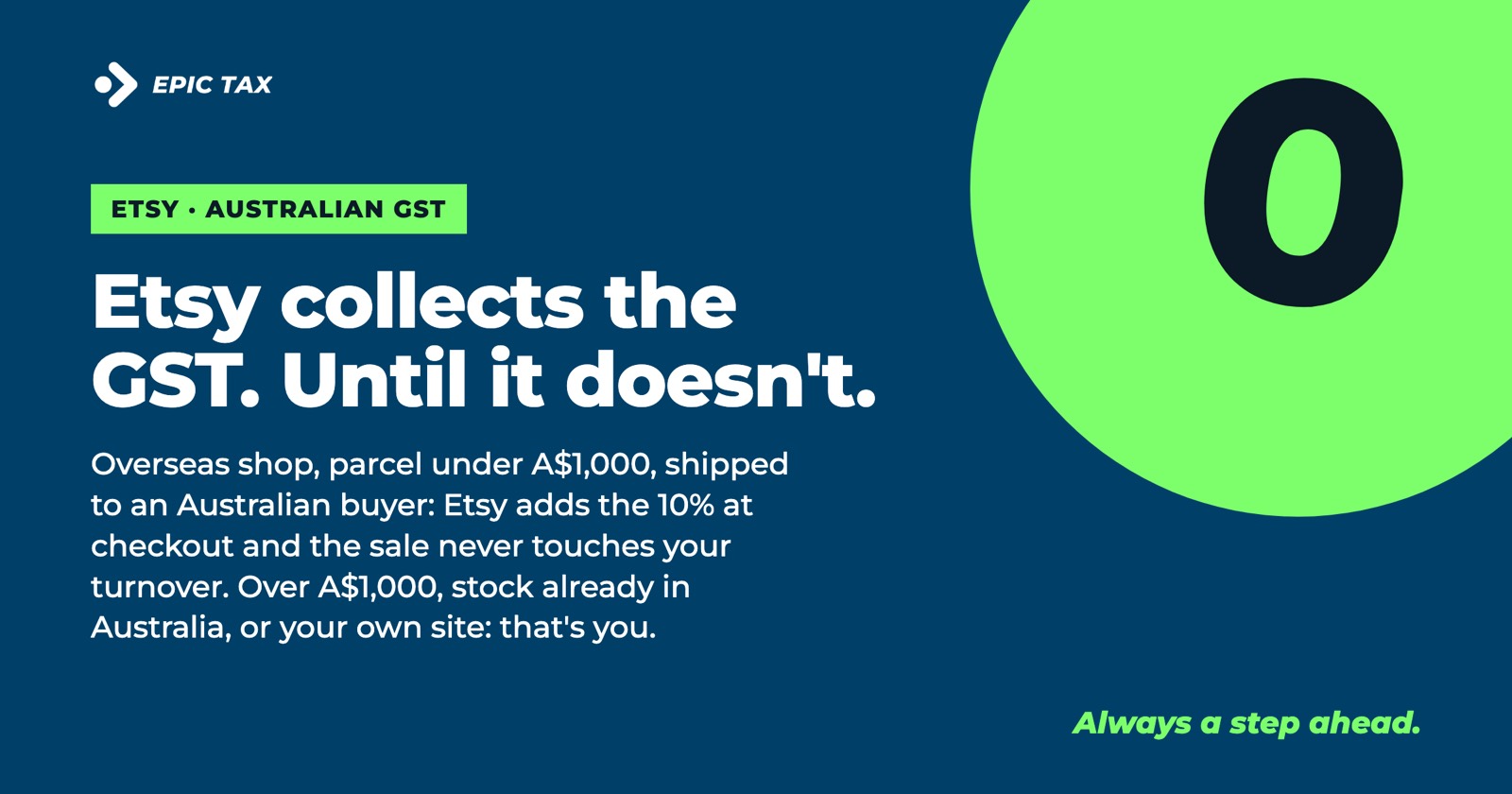
Yes, on three conditions that Etsy publishes itself: the seller is located outside Australia, the package is shipped to a buyer in Australia, and the total value of the package is A$1,000 or less. When all three hold, Etsy adds 10% GST to the buyer’s total at the last step of checkout and remits it to the ATO. The law behind that treats the platform, not you, as the supplier, so those sales do not count toward your A$75,000 registration threshold. Two situations switch the GST back to you: a package over A$1,000, where the buyer pays at the border, and goods already located in Australia when they sell, which are your supplies.
That is the whole answer for most overseas makers. A UK candle shop can ship A$96,000 of orders to Australian buyers in a year and never register, lodge or remit a dollar of Australian GST, because Etsy did all three. The moment the shop puts stock in a Melbourne warehouse, or sends a A$1,350 wedding order, a different rule applies. Below: what happens at checkout, the two exceptions and digital items, the turnover question, GST on seller fees, and what Etsy asks you to put on the customs form.
(General information for FY 2026–27, not tax advice for your circumstances. Etsy’s practice is as published on its help pages, read on 12 October 2026: “Custom Fees and Physical VAT Collection”, “How VAT Works on Digital Items”, “How VAT Is Collected on Seller Fees” and “How to Add or Update Your VAT ID”. The ATO rules are from its pages for merchants, platform operators and Australian business purchasers, and the GST Act. The A$75,000 threshold is not indexed and may change.)
1. Does Etsy charge GST on my sales to Australian buyers, and what happens at checkout?
Etsy’s help page sets it out in one list: “Etsy will collect a 10% GST on orders if each of the following applies: Seller is located outside Australia. The package is being shipped to a buyer in Australia. The total value of the package is less than or equal to $1,000 AUD.” Then: “Etsy automatically includes the tax in the buyer’s total at the last stage of the checkout process. Etsy is then responsible for remitting it to the Australian Taxation Office (ATO).”
So a buyer in Melbourne who puts a A$48 candle with A$12 shipping in the cart sees A$66 at the last step, not A$60. The A$6 goes to Etsy, and Etsy pays it to the ATO. You list the A$48, you receive the A$60 less Etsy’s fees, and the GST never passes through your hands on an Etsy Payments order.
The reason Etsy does this, rather than asking you to, is the electronic distribution platform rule in the GST Act. Section 84-55 says that when a supply is made through an electronic distribution platform, “the operator of the platform, instead of the supplier, is treated, for the purposes of the GST law … as being the supplier of, and as making, the supply”, and section 84-81(3) extends that to an offshore supply of low value goods, meaning a consignment with a customs value of A$1,000 or less shipped from outside Australia to a consumer. A marketplace that lets buyers order and merchants accept, authorises the charge and authorises delivery, is that operator. The ATO’s page for platform operators lists the four conditions and gives the same answer; our article on who the seller of record is walks through the four-step test and the written-agreement exclusion in full, so this one doesn’t repeat it.
Two small things Etsy’s page tells you that the statute doesn’t. First, Etsy’s number: the page publishes “Etsy’s Australian Reference Number (ARN): 3000 0920 7152”. The ATO’s name for that is an ATO reference number, the identifier it issues to an overseas business under simplified GST registration instead of an ABN. That is the number customs may want to see on the parcel (section 5). Second, Etsy’s test is the “total value of the package”, while the Act’s test is the customs value of the consignment, which is the price of the goods without the shipping. For a A$60 parcel the difference is academic. For a parcel priced close to A$1,000 with shipping on top, it is not, and Etsy’s test is the one that decides whether Etsy charges at checkout.
2. When doesn’t Etsy collect: orders over A$1,000, stock already in Australia, and digital items
The same help page names the two exceptions: “Etsy will not collect GST where the total value of the package being imported into Australia is more than $1,000 AUD” and “Etsy will not apply GST to transactions for goods located in Australia.” In both cases the GST doesn’t disappear. It moves.
Over A$1,000: the buyer pays at the border. A consignment with a customs value over A$1,000 is not a low value good, so the platform rule doesn’t apply. GST, any customs duty and a clearance charge are collected from the importer before delivery, and on a direct-shipped consumer order the importer is normally the buyer. The ATO’s wording is blunt: GST “will be charged at the border when goods are imported with a customs value over A$1,000 (even if the supplier incorrectly charged GST on the sale)”. For Hannah’s wedding order of thirty candles at A$1,350, Etsy adds nothing at checkout and the buyer gets a bill from the carrier of roughly A$135 of GST plus any duty and the broker’s fee before the box is released. Tell the buyer before you ship; most of the one-star reviews on big orders are about this bill. Our article on the A$1,000 rule covers how customs value is measured and what to do when one order has to go as two parcels.
Goods already in Australia: you are the supplier. If your stock sits in a Melbourne 3PL and ships to the buyer from there, the goods are in Australia when they sell, so there is no offshore supply for Etsy to be deemed the supplier of. The ATO’s example for exactly this is a Hong Kong seller it calls Household Harriet: a non-resident that “imports goods and warehouses them in Australia prior to selling them online, directly or through an electronic distribution platform, will have a GST obligation for the goods sold because the goods are located in Australia”, and the platform “is not treated as the supplier for GST purposes because the goods are located in Australia at the time of the sale”. That seller has “standard GST registration”, which lets it claim the GST paid on the bulk import, and it “will not be eligible for simplified GST registration”. Standard registration needs an ABN, which an overseas business gets through making supplies connected with Australia; our guide to simplified versus standard registration explains the two tracks.
Digital items: Etsy collects, wherever your shop is. A downloadable pattern or PDF sold to an Australian buyer is an inbound intangible consumer supply, and the platform rule has applied to those since 1 July 2017 with no value threshold at all. Etsy’s digital-items page lists Australia and says: “Etsy automatically detects if the buyer is in one of these countries and adds the appropriate VAT to the listing price if the item is a digital file download … Sellers are not responsible for adding VAT to their digital listing prices.” Etsy’s page uses “VAT” as its generic word and notes it is “also known as … GST” in some countries. Hannah’s A$8 label template shows A$8.80 to a Sydney buyer, and the 80 cents is Etsy’s to remit.
3. Do my Etsy sales count toward the A$75,000 GST registration threshold?
Not the ones Etsy is responsible for. The ATO’s page for merchants says: “If you sell digital products or low value imported goods to customers through an EDP, the EDP operator is generally responsible for GST payable on these sales. If the EDP operator is responsible for GST, these sales don’t count towards your GST turnover when calculating if you need to register.” Your GST turnover also excludes “sales not connected with Australia”. What is left is the sales you are the supplier of.
For an Etsy shop shipping from overseas, three kinds of sale are yours and do count:
- Sales from stock in Australia. Every Etsy order shipped from a 3PL here is your supply, GST included in the price you set, whether or not Etsy’s checkout shows it.
- Sales through your own website. A shopping-cart platform is not an electronic distribution platform, so your own store’s sales to Australian consumers are yours. The ATO says it directly: “Although you do not include the sales you make through the EDP, you will need to register if the value of the sales from your online store meet the GST registration turnover threshold of A$75,000.”
- Direct-shipped parcels over A$1,000. Taxed at the border to the buyer, so in practice nothing for you to remit, but not a platform-responsible sale either.
You reach the threshold when your current turnover (this month plus the previous eleven) or your projected turnover (this month plus the next eleven) is A$75,000 or more, and you then have 21 days to register. The threshold is not indexed and may change.
Hannah’s year. She makes candles in Bristol and sells only on Etsy until the spring.
| Channel | Sales | Who is the supplier | In Hannah’s turnover? |
|---|---|---|---|
| Etsy orders shipped from the UK, 1,600 parcels at A$60 | A$96,000 | Etsy: outside Australia, to an Australian buyer, under A$1,000; Etsy collects A$9,600 | No |
| One wedding order, 30 candles, shipped from the UK | A$1,350 | Border: the buyer pays GST and any duty as importer | No |
| Etsy orders shipped from her Melbourne 3PL stock | A$60,000 | Hannah: goods in Australia when sold | Yes |
| Her own website, shipped from the UK | A$20,000 | Hannah: a shopping cart is not a platform | Yes |
| Turnover for the A$75,000 test | A$80,000 |
Before the 3PL, Hannah’s turnover was nil and the A$96,000 of Etsy sales never came near the test. Once the Melbourne stock is selling and her own site is counted, she is at A$80,000 on the projected test and may need to register: standard registration on an ABN, because the warehoused stock rules out the simplified track. The GST on A$80,000 of GST-inclusive sales is A$7,273. Against that she claims the A$1,500 of import GST she paid at the border when the 1,000 candles arrived (customs value A$15,000), because she is the importer of that consignment and only the importer claims it; our article on who gets the import GST back covers the paperwork. Net: A$5,773 for the year. The A$96,000 of UK-shipped Etsy sales still isn’t in any of those numbers. Etsy remitted its A$9,600 on them and that was the end of it.
One consequence worth stating plainly: even under A$75,000, a seller who has paid import GST on a bulk consignment can only recover it by registering. Voluntary registration is sometimes the money decision, not the compliance decision.
4. Does Etsy charge GST on seller fees, and what does the VAT ID field change?
For a shop based in Australia, yes, unless the shop has given Etsy its ABN. Etsy’s fee page lists Australia among the countries where “Etsy may be required to collect VAT on seller fees accrued each month and remit it to the relevant tax authority”, including “VAT on Etsy Payments processing fees”. The switch is the taxpayer ID: “If you haven’t submitted a VAT ID to Etsy … applicable VAT charges will appear in the current balance in your Payment account”, with an invoice on the first of the following month; “If you added your VAT ID to your Etsy account, you won’t be charged. Instead, you will receive an invoice from Etsy on the first of each month stating that you were not charged VAT on your seller fees.”
For an Australian shop the “VAT ID” is the ABN, entered under Shop Manager, Finances, VAT ID. Etsy says providing it “is establishing a business-to-business relationship between your shop and Etsy”, and that this status and your location “determine whether or not Etsy will charge VAT on seller fees”. The Australian law underneath is the imported-services rule: an overseas supplier charges GST to Australian consumers and to businesses that aren’t registered, and stops charging a business that both “give[s] them your Australian business number (ABN)” and “state[s] that you are registered for GST”. The ATO adds the warning that matters here: “Penalties can apply if you provide false information to a supplier, such as quoting an ABN when you are not GST-registered.” Having an ABN is not the same as being registered for GST. A hobby-scale Sydney shop with an ABN and no GST registration should leave the field empty, pay the 10% on its fees, and treat it as a cost.
A GST-registered shop that gives its ABN is not charged, and the reverse charge that technically replaces it only bites where the shop could not have claimed a full credit anyway, which for Etsy fees used in the business is nowhere. If a registered shop was charged by mistake, the ATO’s route is to ask the supplier for a refund, and Etsy’s monthly invoice is the document for the credit in the meantime.
Hannah’s friend Mei runs a Sydney shop paying about A$3,000 of Etsy fees a year. Without her ABN on file, Etsy adds about A$300 of GST across the year. With it on file and a GST registration behind it, none.
And Hannah herself? Her fee question is a UK one. Australian GST on seller fees is about shops based in Australia. An overseas shop’s fees are taxed, if at all, by its own country’s VAT rules, which is a different list on the same Etsy page.
5. What goes on the customs form, and where does the GST show up in my Etsy payments?
Etsy asks for its own tax details on the parcel. The ATO’s page for merchants explains why: “If an EDP operator is responsible for GST, they need to ensure their tax information is included on customs documents when goods are imported into Australia. This means EDP operators may ask you (as the merchant) to ensure that particular information is included on these documents, such as their GST registration number.”
Etsy’s instruction is specific. If you are outside Australia, the package is A$1,000 or less, and you ship “using a commercial carrier, such as Fedex”, you “may need to include” Etsy’s reference number, 3000 0920 7152, and “the item(s) total, shipping costs, GST charged, and full order total”, because “Australian customs authorities may look at the customs form to confirm that GST was paid on the order.” Sellers using a national post service such as Royal Mail, USPS, Canada Post or PostNL “may not be required to provide this additional information”. And one rule that catches multi-item orders: “Multiple items purchased in the same order should be shipped in the same package.” Split a A$900 order into two boxes and you have two parcels that each look untaxed.
On the money side, an Etsy Payments order is simple: Etsy collects the GST from the buyer and it never reaches your payment account. A PayPal order is the one to understand, because the cash movement looks wrong for a day: “For orders placed through PayPal, Etsy sends the GST collected to the seller as a part of the payment. Etsy then adds the tax to the seller’s Etsy statement so that we can remit the tax to Australian authorities.” The A$6 lands in your PayPal with the A$60, then A$6 is charged to your Etsy statement. It is not your income and it is not your GST; it is Etsy’s, passing through. Book it as a pass-through, not a sale, or your revenue and your fees are both overstated by the same amount.
Where it’s worth getting help
If every parcel ships from your own country and stays under A$1,000, you can apply this yourself: check Etsy’s three conditions, keep one order to one box, put Etsy’s number on courier labels, and let the platform do the rest. Nothing to register.
The judgment calls are these:
- The day stock lands in Australia. From that shipment on, Etsy sales from the warehouse are yours, the projected test starts counting, and the registration is standard, on an ABN, with identity documents that an overseas applicant gets refused on more often than not.
- The bulk consignment itself. Who is named as importer on the declaration decides whether the import GST ever comes back, and that is settled before the goods sail, not at BAS time.
- Orders over A$1,000. Whether to split them, how to warn the buyer, and what the carrier will charge at the door.
- Mixed channels. Etsy from overseas, Etsy from a 3PL, and your own site are three different answers in one business, and the turnover test adds the last two.
That’s the difference between doing it and doing it right the first time: the maker who registered on the right track the week the stock arrived, versus the one who assumed Etsy still had it covered and found out from a BAS that was never lodged.
If you’d like that looked at properly, our initial assessment form scopes it in about twelve questions, including where each channel ships from and whether anything is warehoused here, without a meeting. If the answer is standard registration, our ABN application for overseas sellers is the next step.
FY 2026–27. General information, not tax advice for your circumstances. Etsy’s collection and fee practice is as published on its help pages at 12 October 2026 and may change; the ATO’s platform, merchant and business-purchaser rules are its published settings at the same date. The A$75,000 GST registration turnover threshold is not indexed and may change; confirm the current figure.
Does this apply to you?
Book a free consultation — your situation, your options, and a fixed-fee quote within one business day.