
Do I Charge GST on International Sales from Australia? (2026)
Part of the guide: Do I need to register?
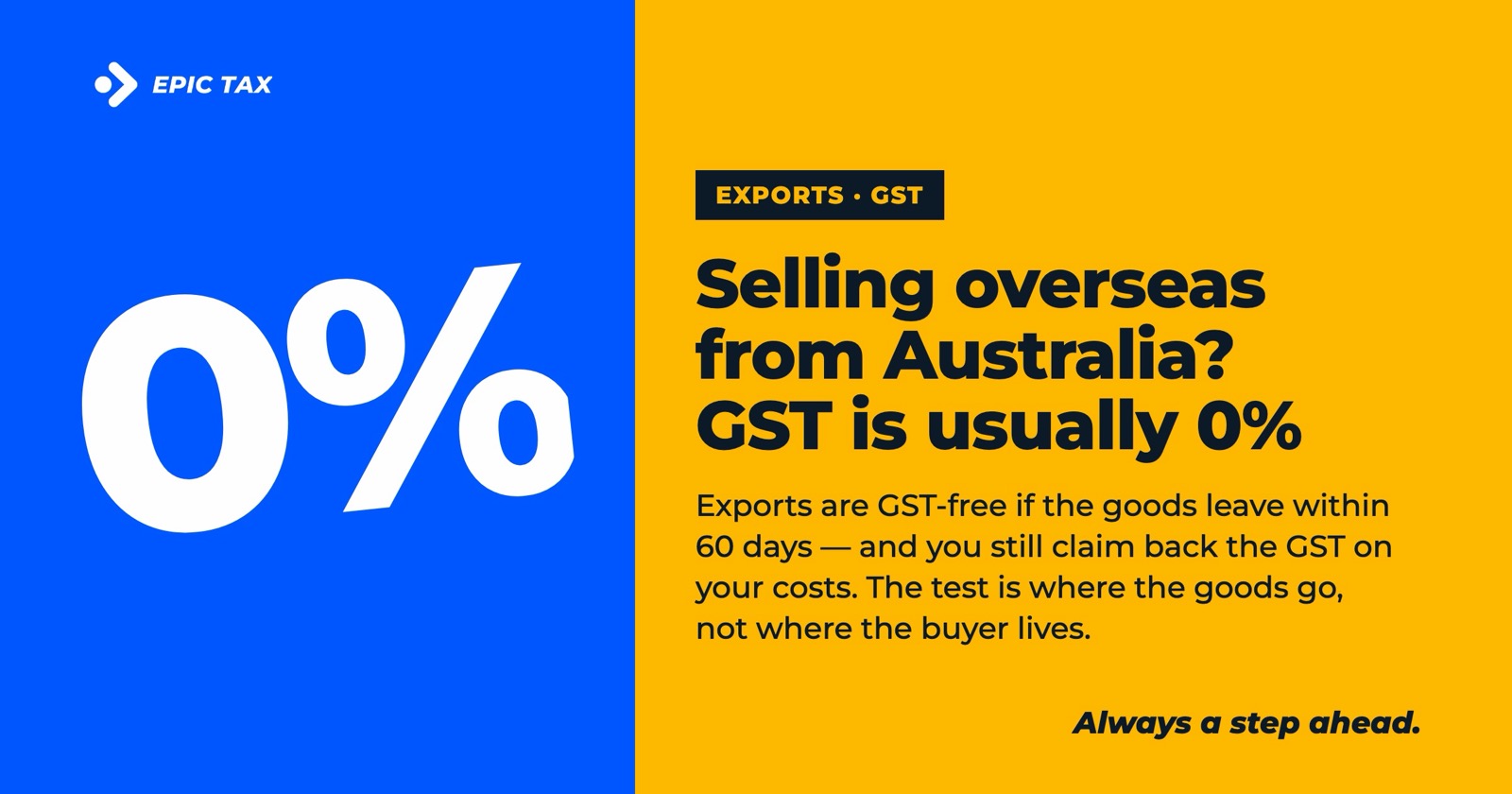
Usually no. Goods you export from Australia are GST-free if they leave the country within 60 days of the earlier of receiving any payment or issuing the invoice — and services and digital products supplied to a non-resident who isn’t in Australia are generally GST-free too. You still claim the full GST credits on your costs. The test is where the goods go and how fast, not where the buyer lives. That one distinction decides whether an “international sale” is GST-free, or an ordinary taxable sale dressed in an overseas email address.
Both mistakes cost real money. Add 10% to a genuine export and you are either 10% dearer than every competitor or holding GST the ATO is entitled to. Treat a taxable sale as an export — an overseas customer collecting in Australia is the classic — and one-eleventh of the price comes out of your own margin when the ATO looks.
| The sale | GST treatment |
|---|---|
| Goods shipped from Australia to an overseas address | GST-free export if they leave within 60 days — don’t charge GST |
| Goods an overseas customer picks up (or sends their Australian freight forwarder to collect) | Normally taxable at 10% — the strict “recipient export” conditions rarely rescue it |
| Services or digital products to a non-resident who isn’t in Australia | Generally GST-free |
| Any of the above, on your BAS | Export sales at G2; full GST credits on your inputs still claimable |
(General information for FY 2026–27, not advice for your circumstances. ATO guidance on exports and GST checked on 8 November 2026. The A$75,000 GST registration threshold is not indexed and may change.)
1. Do I charge GST on international sales from Australia?
Generally no, for goods you ship overseas: the ATO treats exports from Australia as GST-free, provided the goods leave within the 60-day window. You do not add 10% to the price, and the sale still earns you full GST credits on what it cost to make and send.
GST is a tax on consumption in Australia. When the goods are consumed somewhere else, Australia doesn’t tax them — that’s the whole design, and it’s why GST-free exports are a feature, not a loophole. The same logic runs through the rest of this article: the law keeps asking where is this actually consumed?, not what address is on the order?
Three practical consequences:
- Don’t charge GST on a genuine export. Price it GST-free. If you’ve been adding 10% “to be safe”, you’ve been handing your margin to the ATO or overpricing yourself — and unwinding it is awkward (section 5).
- An overseas buyer does not automatically make an export. If the goods never leave Australia, or leave outside the rules, the sale is taxable no matter where the buyer lives. The delivery trap in section 3 catches more sellers than any other part of this topic.
- GST-free is not “outside the system”. The sale is still reported on your BAS (label G2), still counts towards the registration threshold (section 5), and still needs evidence (section 2).
2. What is the 60-day rule for GST-free exports?
The goods must physically leave Australia within 60 days of the earlier of the day you receive any of the payment or the day you issue the invoice, according to the ATO. Paid in instalments? The 60 days run from the final instalment. If you can’t make the deadline, you can ask the ATO for an extension through Online services for business — before the time runs out.
The clock starts earlier than most sellers expect. Take a deposit on day one and the 60 days are already running, even if the balance lands weeks later — the trigger is any payment or the invoice, whichever comes first. (The one carve-out worth knowing: a new boat sold for private recreational use has 12 months, provided it’s exported within that time.)
What keeps a sale GST-free in practice is the paper trail. Keep, for each export:
- the export declaration lodged with customs (or your freight forwarder’s copy);
- the bill of lading or air waybill showing the goods leaving Australia;
- the commercial invoice and transport documents tying these goods to this sale;
- anything showing the dates — because the 60 days are measured, not assumed.
Miss the window without an extension and the supply stops being GST-free. The price you charged is then treated as GST-inclusive: one-eleventh of it is GST, payable out of your pocket, because you can hardly go back to the customer for 10% more. The detailed rules are in the ATO ruling GSTR 2002/6; the habit that matters is simpler — invoice late, ship fast, and file the evidence the week the goods leave.
3. What if my overseas customer takes delivery in Australia?
Then it is normally a taxable sale at 10%, whatever the buyer’s home address, according to the ATO’s export rules. Handing the goods to the customer in Australia — or to their nominated freight forwarder in Australia — generally means you are not the exporter, and the GST-free export treatment doesn’t apply to you.
This is the trap inside “can we charge GST to overseas customers?” — sometimes you must. The export exemption belongs to sales where the supplier sends the goods out of the country. The moment your delivery obligation ends at an Australian door — the buyer’s agent, their consolidator, an EXW pickup from your warehouse — the export is happening on someone else’s watch, and your supply defaults to taxable.
There is a narrow rescue: the law can treat the buyer’s export as yours (a “recipient export”), but every condition has to hold, including that the buyer is a non-resident who isn’t registered (or required to be registered) for GST, the goods leave within the 60 days, they aren’t used or altered in Australia first, and you hold the documentary evidence that all of it happened. The ATO’s practice statement is blunt about the standard: a declared intention to export, or a copy of the buyer’s ticket, is not evidence. If you can’t get the export declaration and transport documents into your own file, charge the GST.
A registered Australian buyer — including the local arm of an overseas group — never fits the concession. Invoice those sales with GST like any domestic sale; if they export the goods, that is their supply chain, not yours. And if the buyer is themselves an overseas business paying Australian GST on local costs, our article on claiming GST on overseas purchases covers the mirror image of this question.
4. Do I charge GST on services and digital products sold to overseas customers?
Generally no: a service or digital product supplied to a non-resident who is not in Australia when the work is done is generally GST-free. Consulting, design, development, software subscriptions, marketing services — exported services follow the same consumption logic as exported goods, without a 60-day clock.
Because there’s no shipping document for a service, the two facts to evidence are who you supplied and where they were:
- Non-resident customer. A business established overseas, or an individual who lives overseas. Keep what shows it — the contract, the billing address, the ABN check that comes up empty, correspondence.
- Not in Australia when the thing is done. If the overseas company’s staff are in Australia working with you while you perform the service, or the service is really being consumed by their Australian office, the exemption wobbles.
The clawback to respect: a supply made to a non-resident but provided to someone in Australia can lose its GST-free status. Classic example — an overseas parent pays you to train the staff of its Australian subsidiary. The contract is foreign; the consumption is here; the supply may be taxable. The ATO has been rewriting its detailed ruling on this boundary, so for anything structured — multi-entity groups, global contracts with Australian beneficiaries — get the position checked rather than pattern-matched.
One more boundary worth naming: everything above is about exporting services from Australia. Selling into Australia as a non-resident runs on different rules — that side of the story is our non-resident GST registration guide.
5. Do GST-free exports count towards the A$75,000 threshold — and can I still claim GST credits?
Yes to both, according to the ATO. GST-free export sales are connected with Australia, so they count in your GST turnover for the A$75,000 registration threshold — the ATO’s own example makes the point. And once registered, you claim the full GST credits on inputs used to make those GST-free sales: packaging, freight, platform fees, rent, the lot.
“GST-free” and “input-taxed” are different animals, and the difference is money. Input-taxed sales (think residential rent) sit outside GST turnover but kill the credits behind them. GST-free sales do the opposite: they count towards the threshold, and they keep every credit alive. A business selling mostly exports often collects little or no GST at G1/G2 while claiming steady credits at 1B — a net refund position, quarter after quarter. That refund is not a red flag; it’s the system working.
Priya’s quarter makes it concrete (illustrative figures):
| Priya’s Melbourne studio — one quarter | Amount | GST |
|---|---|---|
| Export sales (shipped within 60 days, evidence filed) | A$22,000 | nil — reported at G2 |
| Australian sales | A$11,000 incl GST | A$1,000 collected |
| Business inputs (stock, packaging, freight, fees) | A$8,800 incl GST | A$800 credit |
| Net GST to the ATO | A$200 |
Her GST turnover for the threshold question counts both streams — about A$122,000 annualised — so she may need to be registered even though two-thirds of her sales carry no GST. If she had added 10% to the exports “to be safe”, that’s A$2,200 collected as GST: the ATO’s position is that wrongly charged GST generally stays payable until the customers are reimbursed. Unwinding 10% from dozens of small overseas orders is nobody’s idea of a good month — the cheaper path is classifying the sales correctly before the first one ships. New to the BAS side of this? Our first BAS guide for sellers walks the labels.
Getting it set up
The free path is all public: the ATO’s Exports and GST page has the 60-day rule and the evidence standard, GSTR 2002/6 has the detail, and your BAS has a G2 label waiting. Nothing above needs a tax agent to read.
What an agent changes is the order and the defaults. We set up exporting clients so the answer is right from the first order: sales channels mapped to GST codes (export, domestic, the collect-in-Australia exception), the 60-day clock tracked from deposit date rather than ship date, the evidence file built into the dispatch routine instead of reconstructed at BAS time, and the registration question answered with both streams counted. That’s usually a one-off setup conversation — much cheaper than refunding GST to forty customers, or finding out in an ATO review that a year of “exports” were collected at your warehouse door.
Start with an initial assessment — tell us what you sell and where it ships, and we’ll tell you which of your sales are GST-free, what evidence to keep, and whether you need to be registered at all.
(General information for FY 2026–27, not advice for your circumstances. ATO guidance on exports and GST checked 8 November 2026. Worked figures are illustrative. You may need to register for GST once your GST turnover reaches A$75,000.)
Does this apply to you?
Book a free consultation — your situation, your options, and a fixed-fee quote within one business day.