
Medicare levy exemption: how to get the 2% back (FY2025-26)
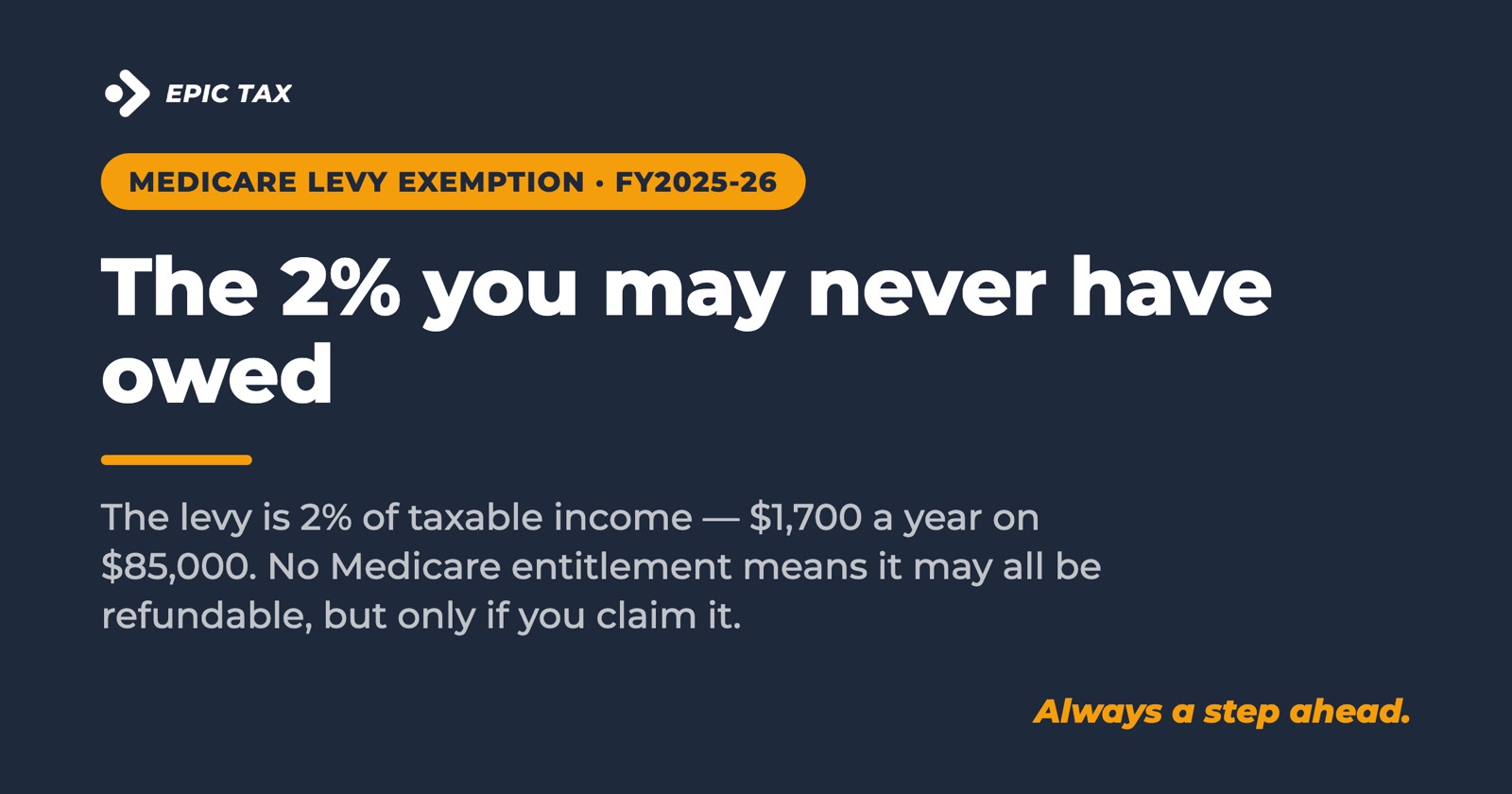
Look at your last payslip. Somewhere in the tax that came out is the Medicare levy — 2% of your taxable income, taken quietly, every pay, all year.
On $85,000, that’s $1,700 a year.
Here’s the part that surprises people: if you weren’t entitled to Medicare — which is the everyday position of most people on a 500, 485 or 482 visa — that $1,700 may never have been yours to pay. And this isn’t a deduction that shaves a few hundred off your taxable income. The exemption removes the tax itself, dollar for dollar. Claim it, and the whole $1,700 comes back in your refund.
Below is how it works for FY2025-26 — the year most people are lodging right now — verified against the ATO and Services Australia. (General information only, not personal advice.)
1. Not entitled to Medicare? The whole 2% may be refundable
Most Australian tax residents pay the 2% levy on top of their income tax. There are three exemption categories: a medical category (blind pensioners, DVA Gold Card holders, full free ADF medical treatment), a foreign resident category, and — the one that matters to temporary visa holders — Category 3: not entitled to Medicare benefits.
If you paid for OSHC or private cover because Medicare wasn’t available to you, you’re the person Category 3 was written for.
The arithmetic is as blunt as it looks:
| Taxable income (FY2025-26) | 2% Medicare levy | Exempt all year |
|---|---|---|
| $60,000 | $1,200 | $0 |
| $85,000 | $1,700 | $0 |
| $110,000 | $2,200 | $0 |
Two conditions before you get excited. First, the exemption is not automatic — the levy has already been withheld through PAYG in every pay, and the only way it comes back is by lodging your return and completing item M1, “Medicare levy reduction or exemption”. Skip M1 and you have simply paid it. Second, Category 3 needs paperwork: a Medicare Entitlement Statement.
(Don’t confuse this with the Medicare levy surcharge — the extra 1–1.5% charged to higher earners without private hospital cover. Different rule, different topic.)
2. The Medicare Entitlement Statement — the paperwork that unlocks it
A Medicare Entitlement Statement (MES) is a document from Services Australia confirming the period in a financial year when you were not entitled to Medicare benefits. It’s the evidence behind your M1 claim.
What to know before you apply:
- Three ways to apply, and myGov is only one of them. Online through myGov, in the Medicare Entitlement Statement section of the Individual Healthcare Identifiers service; on paper, using form MS015; or with the help of a registered tax agent, who can guide the application and then make the M1 claim on your return. If myGov linking has ever defeated you, the agent route exists for exactly that reason.
- One statement per financial year. You apply from 1 July for the year that has just ended — you can’t get a statement for a year that’s still running.
- Leaving Australia? There’s an exception: you may apply from 1 July for the current year, up to four weeks before you depart. Worth diarising if you’re heading home mid-year.
- Allow up to eight weeks if you apply between July and November. That’s the peak, and it’s the single most common reason people miss the 31 October lodgment date.
- You keep the statement — you don’t attach it to your return. You transfer the dates from it into M1.
Apply early. The MES is slow; the refund is not.
3. A temporary visa does not automatically mean exempt
This is where good claims go wrong. Plenty of people on temporary visas are entitled to Medicare, and for them the levy is correctly charged. You may still be entitled if:
- You applied for a permanent visa, you hold a valid temporary or bridging visa, and either you have permission to work, or a spouse, parent or child of yours is an Australian citizen, permanent resident or eligible New Zealand citizen. (This is the blue Medicare card situation.) It isn’t automatic — Services Australia decides whether your particular application and bridging visa qualify.
- You hold a passport from one of the 11 Reciprocal Health Care Agreement countries — Belgium, Finland, Italy, Malta, the Netherlands, New Zealand, Norway, the Republic of Ireland, Slovenia, Sweden and the United Kingdom. Visitors from these countries can access medically necessary care through Medicare, so the exemption generally doesn’t apply. Cover from Italy and Malta runs for six months from arrival, so a longer stay may change your position after that point.
- You’re a New Zealand citizen, a permanent resident, or a citizen.
China has no Reciprocal Health Care Agreement with Australia — so a Chinese-passport student, graduate or skilled-visa holder with no permanent residency application on foot is the typical Category 3 case.
One more trap worth naming: holding an MES doesn’t by itself make you exempt. The dependants condition in the next section still has to be met. Services Australia decides your Medicare entitlement; the ATO decides your levy.
4. Full exemption, half exemption, and counting days
The exemption is claimed by days, not by ticking a box. Item M1 has two separate fields: your number of full-exemption days and your number of half-exemption days. The levy is then pro-rated across the year.
You may claim a full exemption for days you were in an exemption category and either you had no dependants, or all your dependants were also in an exemption category, or a dependent spouse was liable to pay the levy themselves.
You may claim a half exemption for days you were in a category but had at least one dependant who was not exempt and not paying the levy in their own right. The ATO’s own example is a spouse whose taxable income sits under the low-income threshold: she owes no levy, so nobody in the household is covering it — and her exempt partner drops from a full exemption to a half. A written family agreement, signed by both spouses, settles who claims which where both of you would otherwise be liable.
Day counting matters most when you arrive or leave part-way through the year. Take the same $85,000 earner whose MES covers 200 days, with a Medicare entitlement for the other 165:
$85,000 × 2% = $1,700 → charged for 165 days only → $1,700 × 165 ÷ 365 ≈ $769 Refunded: about $931, not the full $1,700.
Use the exact dates the MES gives you. Estimating here is what triggers an ATO adjustment later.
5. Missed it in earlier years? Claim them back
If you’ve been here three years and never claimed, you’ve probably paid the levy three times over. You can generally fix that.
Individuals have two years to amend an assessment, running from the day after the notice of assessment was issued. The ATO’s own example: a notice issued 3 November 2026 can be amended until 4 November 2028. Past that window you may still be able to lodge an objection, and an extension of time can be requested in some circumstances — it’s not automatic, but it’s not always closed either.
The order of operations matters:
- Apply for an MES for each earlier financial year — earlier years can still be requested.
- Once each statement arrives, amend that year’s return in myGov (or through a registered agent), completing M1 with the exempt days.
- Refunds are assessed year by year, so each amendment stands on its own.
Two prior years at $85,000 is about $3,400 — for perhaps an hour of paperwork. That’s the reason not to leave it until the two-year window closes.
6. On a low income, the levy switches itself off
The exemption categories aren’t the only way out. If your income is low enough, the levy simply doesn’t apply — no visa question, no statement required.
For FY2025-26, a single person pays no levy at a taxable income of $28,011 or less. Above that, the levy phases in at 10 cents per dollar until it reaches the full 2% at $35,013.
Single, taxable income $30,000: 10% × ($30,000 − $28,011) ≈ $199 — not the $600 that a flat 2% would suggest.
Two details people get wrong. The test uses taxable income — after deductions — not your gross salary, so deductions can pull you under the line. And higher thresholds apply to seniors and pensioners entitled to the seniors and pensioners tax offset, which is a separate calculation worth checking if that’s you.
FY2026-27 thresholds are indexed each year and hadn’t been published at the time of writing — so use the FY2025-26 figures for the return you’re lodging now, and confirm the new ones before relying on them next year.
7. A spouse and children lift the bar
Once you have a spouse or dependent children, the family thresholds replace the single one, and they’re tested on combined taxable income — yours plus your spouse’s.
For FY2025-26: no levy at combined taxable income of $47,238 or less, with the full 2% only from $59,047 — and both figures rise by $4,338 for each dependent child.
Couple with two children: threshold $47,238 + (2 × $4,338) = $55,914. The full 2% doesn’t bite until combined taxable income reaches about $69,892.
That’s a meaningful gap, and it’s the reason a single-income family whose earner is over the single threshold can still pay little or no levy.
The two rules also interact. If you’re exempt under Category 3 but your spouse is entitled to Medicare and isn’t liable for the levy themselves, you’re generally in half exemption territory rather than full — which is exactly the situation the two boxes at M1 exist to handle.
The one-line takeaway: the Medicare levy is 2% of your taxable income, it’s already been taken out of every pay, and if you weren’t entitled to Medicare it was never yours to pay — but no one refunds it for you. Get the statement, complete M1, and go back through the years still inside the amendment window.
Figures are FY2025-26 and were verified against the ATO and Services Australia at the time of writing. Thresholds are indexed annually and your entitlement depends on your visa, your family and your income — confirm your own position before you act. General information only, not personal advice.
Does this apply to you?
Book a free consultation — your situation, your options, and a fixed-fee quote within one business day.