
Non-Resident Tax Rates in Australia: Companies and Individuals (2026–27)
Part of the guide: Staying compliant
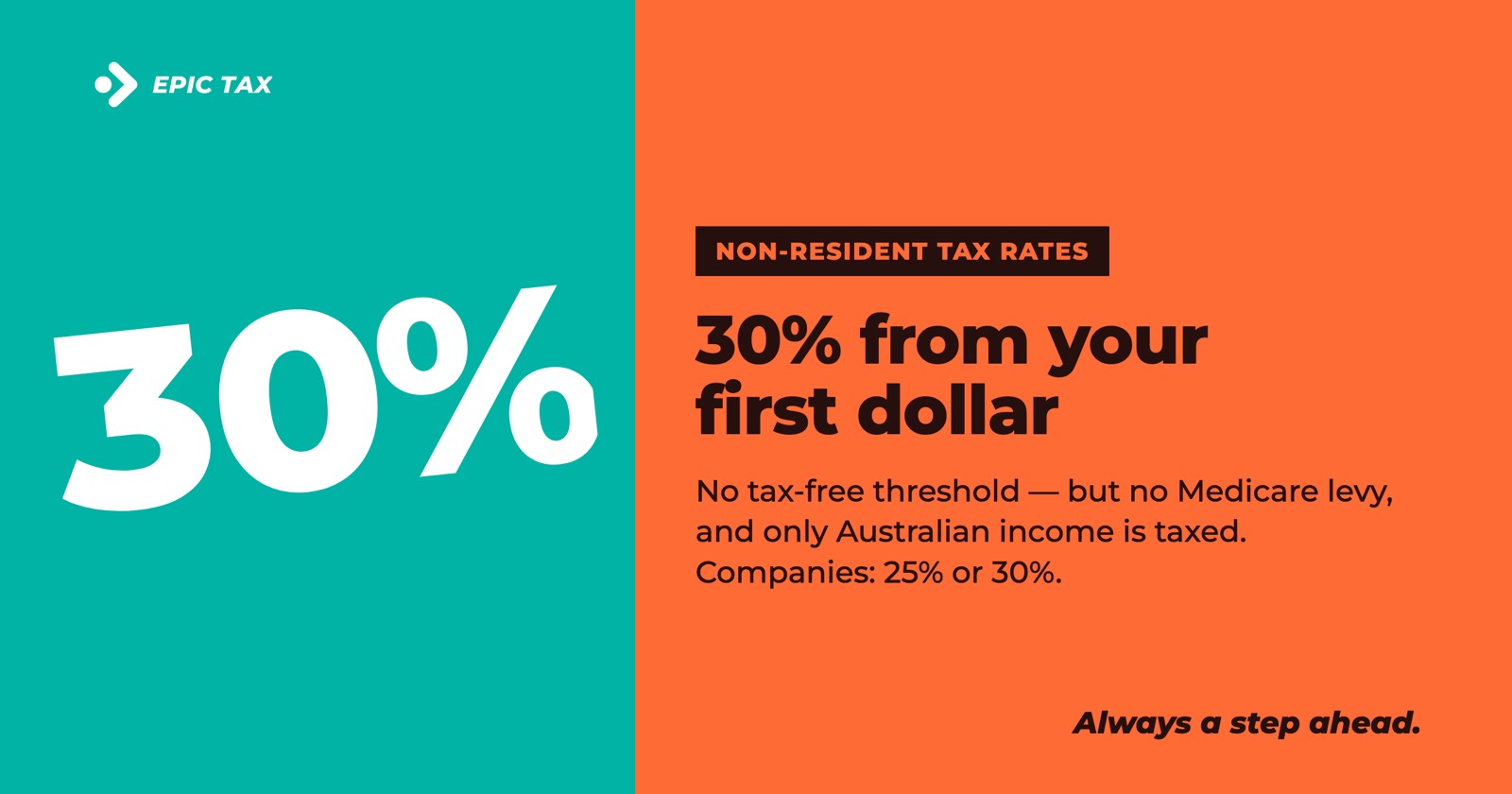
A foreign resident individual pays 30% from the first dollar up to $135,000, then 37%, then 45%. There’s no tax-free threshold — but there’s also no Medicare levy, and only your Australian-sourced income is taxed here.
A foreign company pays a flat 25% or 30%, depending on its turnover and the kind of income it earns. For an overseas seller choosing how to hold an Australian business, that gap between the individual scale and the company rate is usually the whole conversation.
| Foreign resident | Australian resident | |
|---|---|---|
| First $18,200 | 30% | Nil |
| $18,201 – $45,000 | 30% | 15% |
| $45,001 – $135,000 | 30% | 30% |
| $135,001 – $190,000 | 37% | 37% |
| $190,001 + | 45% | 45% |
| Medicare levy | None | 2% |
| Income taxed | Australian-sourced only | Worldwide |
(General information for FY 2026–27, not tax advice for your circumstances. Rates checked against the ATO and the Income Tax Rates Act 1986 on 18 September 2026.)
1. What is the non-resident tax rate in Australia?
30c in the dollar from your first dollar of Australian income up to $135,000; $40,500 plus 37c in the dollar from $135,001 to $190,000; and $60,850 plus 45c above $190,000. No tax-free threshold, and no Medicare levy.
| Taxable income (Australian-sourced) | Tax on this income |
|---|---|
| $0 – $135,000 | 30c for each $1 |
| $135,001 – $190,000 | $40,500 plus 37c for each $1 over $135,000 |
| $190,001 and over | $60,850 plus 45c for each $1 over $190,000 |
Why you won’t find a “2026–27” foreign resident table on the ATO’s site. The ATO publishes one table per year for residents, and added a 2026–27 one when the new bracket started. It doesn’t need to for foreign residents, because the law sets a single table headed “for the 2024–25 year of income or a later year of income” — it already covers this year.
The rates themselves come by cross-reference. Schedule 7 Part II of the Income Tax Rates Act 1986 doesn’t state percentages at all. It says income up to $135,000 is taxed at the second resident personal tax rate, $135,001–$190,000 at the third resident personal tax rate, and anything above $190,000 at 45%. Those are defined as item 2 and item 3 of the resident table for that year — 30% and 37% in 2026–27.
So this year’s tax cut doesn’t touch foreign residents: it changed item 1, the bracket between $18,201 and $45,000, from 16% to 15%, and the foreign resident table never points at item 1. On the same wording the rates hold for 2027–28 too, when item 1 falls again to 14%.
Why the first-dollar rate hurts, and where it stops hurting. Because residents get $18,200 tax free and a 15% bracket after that, the gap is widest at modest incomes, and narrows as income rises:
| Taxable income | Foreign resident | Resident, including 2% Medicare levy | Difference |
|---|---|---|---|
| $50,000 | $15,000 | $6,520 | $8,480 |
| $80,000 | $24,000 | $16,120 | $7,880 |
| $135,000 | $40,500 | $33,720 | $6,780 |
| $200,000 | $65,350 | $59,870 | $5,480 |
What’s actually taxed. A foreign resident is taxed on Australian-sourced income: rent from Australian property, Australian employment income, business profits from an Australian source, and capital gains on taxable Australian property. Your income at home isn’t taxed here. That’s the trade for losing the threshold, and for many overseas sellers it’s a better deal than it first looks.
Residency is a test, not a choice. You don’t tick a box to be a foreign resident. It’s decided by the residency tests, and the answer drives everything on this page — we cover them in Australian tax residency.
2. What’s the company tax rate for a foreign company?
25% if the company is a base rate entity, otherwise 30% — flat, from the first dollar, with no threshold and no levy.
| Company | Rate |
|---|---|
| Base rate entity | 25% |
| Every other company | 30% |
A company is a base rate entity if both are true:
- its aggregated turnover in the previous income year was under $50 million; and
- 80% or less of its assessable income is base rate entity passive income — broadly interest, rent, royalties, dividends and net capital gains.
Two traps for overseas groups. First, aggregated turnover includes connected and affiliated entities, including international ones — a small Australian company inside a large foreign group can fail the $50m test on the group’s numbers. Second, a company earning mostly rent or interest can fail the 80% test even when it’s small, and pay 30%.
Why it matters for e-commerce sellers. On A$200,000 of taxable income, a base rate entity pays $50,000; at 30% it’s $60,000. Run the same profit through your own hands as a foreign resident individual and it’s $65,350. The comparison isn’t complete — getting profits out of a company brings its own tax — but at these levels the entity decision is worth more than most deductions.
3. Tax rates for foreigners on Australian investment income
Investment income usually isn’t taxed on the scale above at all. It’s taxed by withholding at the source: 10% on interest, 30% on unfranked dividends and royalties — less where a treaty says so.
| Payment to a foreign resident | Withholding rate | Typical treaty rate |
|---|---|---|
| Interest | 10% | 10% |
| Unfranked dividends | 30% | often 15% |
| Royalties | 30% | often 10% |
Australia has tax treaties with over 40 countries, and where a treaty sets a lower rate, the treaty rate applies. Check your own country’s treaty rather than assuming the headline number.
Two points that save real money:
- Franked dividends. Dividends paid out of profits the company has already paid Australian tax on and franked are generally not taxed again in the shareholder’s hands when they’re paid to a foreign resident. The 30% applies to the unfranked part.
- Withholding is usually final. For interest, unfranked dividends and royalties, the withholding generally settles the Australian tax — that income doesn’t go into an Australian return as well.
Property is different. If you sell Australian real property under a contract entered into from 1 January 2025, the buyer must withhold 15% of the price — not of your gain — with no minimum value threshold. That’s a prepayment, not the final tax: you lodge a return, the actual tax on the actual gain is worked out, and the difference comes back. The two numbers are never the same, and it’s worth applying for a variation before settlement if the real tax will be well under 15% of the price.
4. Working it out: calculators, working holiday makers, and part-years
For a straight full-year calculation, use a calculator rather than the table — and if you’re on a 417 or 462 visa, a different and much friendlier scale applies to you.
Working holiday maker rates (2025–26 published scale):
| Taxable income | Tax on this income |
|---|---|
| $0 – $45,000 | 15c for each $1 |
| $45,001 – $135,000 | $6,750 plus 30c for each $1 over $45,000 |
| $135,001 – $190,000 | $33,750 plus 37c for each $1 over $135,000 |
| $190,001 and over | $54,100 plus 45c for each $1 over $190,000 |
At $45,000 that’s $6,750, against $13,500 on the ordinary foreign resident scale — the reason the visa subclass and your employer’s registration status matter so much on a working holiday.
Calculators. The ATO publishes a Simple tax calculator (tax on a full-year taxable income) and an Income tax estimator (refund or debt). Our own tax refund estimator has a non-resident mode, which applies the foreign resident scale and leaves the Medicare levy out.
Part-years are the common trap. If you stopped being a resident partway through the year, you don’t get a full year of either scale — the threshold is pro-rated for the resident part, and the foreign resident scale applies to the rest. A calculator built for a full year will overstate your refund. That’s the point to get advice rather than a number off a website.
What to do next
If you’re a foreign resident with Australian income, three questions decide your tax bill, in this order:
- Are you actually a foreign resident? It’s a test on your facts, not an election.
- In whose hands is the income? Yours, at 30% from the first dollar, or a company’s, at 25% or 30%.
- Is it the kind of income that’s withheld at source instead? Interest, dividends and royalties usually are, often at a treaty rate — and property sales are prepaid at 15% of the price.
The rate tables are free on the ATO website, and so are its calculators. Nothing here needs an agent to look up.
Where a registered tax agent earns their fee is in the two decisions the tables can’t make for you: your residency position, and which entity holds the Australian income — both best settled before the income year starts. Changing an entity afterwards means transfers, possible capital gains, and a year of returns already lodged on the old basis.
If you want a quick read on your position, tell us where you live, what the Australian income is, and who currently earns it. That’s usually enough to say which of these scales you’re on.
Epic Tax is a registered tax agent in Australia working with overseas e-commerce sellers and investors. This article reflects ATO rates published as at 18 September 2026 and is general information only — it does not take account of your circumstances. The foreign resident rates are those set by Schedule 7 Part II of the Income Tax Rates Act 1986 (Compilation No. 66, in force 1 July 2026), which applies to the 2024–25 year of income and later years.
Sources: Income Tax Rates Act 1986 (Compilation No. 66, in force 1 July 2026), Schedule 7 Parts I and II and the definitions in section 3; ATO — Tax rates – foreign resident, Tax rates – Australian resident, Tax rates – working holiday maker, Company tax rates (QC 17534), base rate entity guidance, Withholding rate (QC 81820); ATO foreign resident capital gains withholding guidance.
Does this apply to you?
Book a free consultation — your situation, your options, and a fixed-fee quote within one business day.