
Importing from China to Australia: Duty, GST and the ChAFTA Saving (2026)
Part of the guide: Import GST and duty
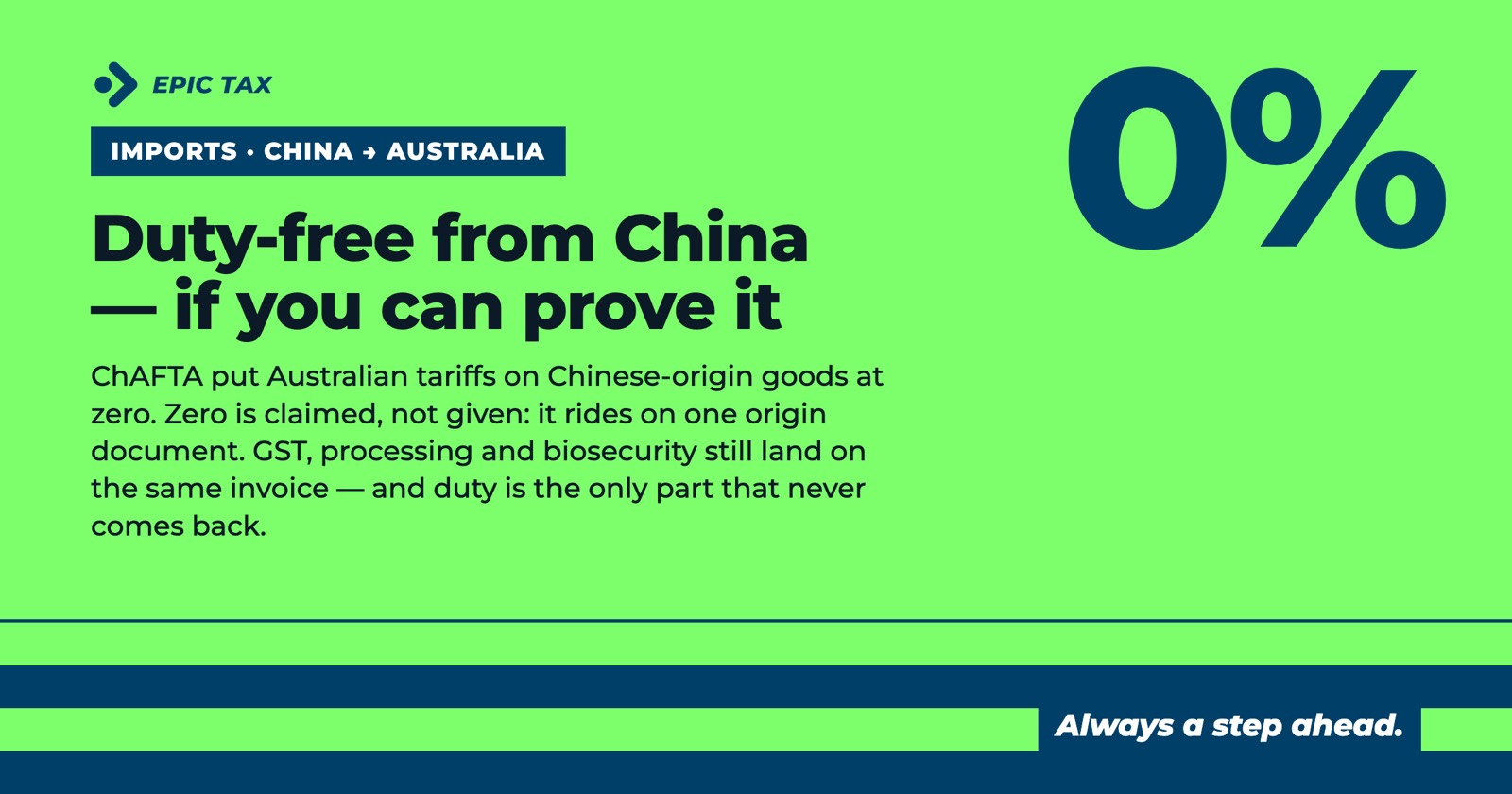
Most Australian importers still price Chinese stock with duty baked into the landed cost. For the great majority of goods, it shouldn’t be there at all.
Under the China–Australia Free Trade Agreement, Australian tariffs on Chinese-origin goods were eliminated in stages — 82 per cent of them on the day the agreement took effect, and the rest from 1 January 2019. Schedule 12 of the working tariff, the schedule that covers Chinese originating goods, now opens with a single sentence: “Except for the subheadings outlined in the table below, all rates are Free.” The table that follows is alcohol, tobacco and fuel.
So why do importers still pay duty on Chinese goods? Because zero is claimed, not given. The preferential rate depends on the goods qualifying under ChAFTA’s rules of origin and on an origin document travelling with the shipment. Without it, the general rate applies — and duty is the one line on a border invoice that a GST-registered business never gets back.
| Importing from China in one line | |
|---|---|
| The duty rate | Free for Chinese originating goods under ChAFTA — the general rate (commonly 5%) if origin isn’t established |
| What duty is charged on | The customs value: the price of the goods, converted at the day-of-export rate. Freight and insurance are outside it |
| What proves origin | A ChAFTA Certificate of Origin from China Customs or the CCPIT, or a Declaration of Origin where an advance ruling covers the goods |
| When no document is needed | Total customs value under A$1,000 |
| GST at the border | 10% of customs value + duty + freight + insurance |
| Other charges | Import processing charge A$50 or A$152; biosecurity charge A$71 by sea, A$48 by air — on consignments over A$1,000 |
| What comes back | The GST, as a credit on the BAS — but only to the entity named on the import declaration |
| What never comes back | The duty |
(General information for FY 2026–27, not tax advice for your circumstances. Every figure below was checked on 24 September 2026 against abf.gov.au — the working tariff Schedule 12, the Import Processing Charges page, the Import declarations page and the GST and other taxes page — against dfat.gov.au for the ChAFTA rules, and against ato.gov.au QC 16237 and the deferred GST page.)
1. How much import duty do you pay bringing goods from China to Australia?
For goods that qualify as Chinese originating goods under ChAFTA, the rate is Free. Schedule 12 of the Customs Tariff states that “except for the subheadings outlined in the table below, all rates are Free”, and the exceptions are the excise-equivalent lines — beer, wine and spirits, tobacco, and petroleum products. If origin is not established, the goods fall back to the general rate in Schedule 3, which is commonly 5% but varies by tariff line.
Whatever the rate, it is applied to the customs value, and that is narrower than most people expect. Customs value is the transaction value — the price actually paid or payable for the goods — converted to Australian dollars at the exchange rate applying on the day the goods were exported (Customs Act 1901, section 161J). International freight and insurance are not part of it. A A$24,000 order that cost another A$2,600 to ship and insure has a customs value of A$24,000, and duty, if any, is charged on A$24,000.
The rate itself follows the tariff classification, not the description on the supplier’s invoice. Two products that look similar in a catalogue can sit in different tariff lines with different rates. Samples read from Schedule 3 in September 2026: cotton and man-made-fibre T-shirts of heading 6109 carry 5%; dolls (9503.00.20) and toy animals (9503.00.30) carry 5%; wheeled ride-on toys (9503.00.10) are Free. There is no single “import duty rate” for China, and there is no substitute for classifying the goods properly before you price the landed cost.
Two things sit outside this and are worth knowing about before they surprise you:
- Alcohol, tobacco and fuel. These are excluded from the Schedule 12 free rates and carry excise-equivalent duties regardless of origin. They also attract duty and GST at any value, even under A$1,000.
- Anti-dumping and countervailing measures. These are separate from tariffs and unaffected by ChAFTA. A number of current measures apply to goods from China. If your product sits in a commodity class covered by a measure, an additional duty can apply on top of everything else — check the Anti-Dumping Commission’s Dumping Commodity Register for your goods.
2. Does ChAFTA make it duty-free — and what do you need to claim it?
Yes, for Chinese originating goods — and the claim rides on an origin document. ChAFTA entered into force on 20 December 2015 and, in DFAT’s words, “set Australian import tariffs at zero on 82 per cent of China’s exports to Australia from day one, rising to 100 per cent tariff elimination by 1 January 2019”. Goods that do not comply with the rules of origin “will be subject to the general (MFN) rate of duty”.
“Made in China” is not the origin test
The phrase on the box has no legal weight at the Australian border. A good is originating under ChAFTA if it falls into one of three categories:
- Wholly obtained — exclusively derived from one country. Typically agricultural goods and natural resources, plus goods made exclusively from wholly obtained goods.
- Wholly produced — produced entirely in China or Australia (or both) from materials that are themselves originating.
- Meets the Product Specific Rule — the category almost all manufactured goods fall into. Goods made with inputs from outside China and Australia still originate if those non-originating inputs are substantially transformed, as defined by the rule for that tariff line in ChAFTA Chapter 3, Annex II.
Most product-specific rules use a change in tariff classification test, at one of three levels:
| Rule | What has to change | Example |
|---|---|---|
| CC — change in chapter | the first 2 digits of the HS code | steel (Chapter 72) → spanners (8204) |
| CTH — change in tariff heading | the first 4 digits | pure gold (7108.13) → gold jewellery (7113.19) |
| CTSH — change in tariff subheading | the first 6 digits | antisera (3002.10) → vaccine (3002.20) |
Some rules instead (or additionally) require a regional value content — a set proportion of the good’s value added in China or Australia.
Three qualifiers matter in practice:
- De minimis. If non-originating materials that fail the classification change are worth no more than 10 per cent of the value of the good, the good still qualifies (ChAFTA Article 3.7).
- Cumulation. Australian-originating inputs used in Chinese production are treated as Chinese (Article 3.4). Components you exported to your own contract manufacturer count in your favour.
- Minimal operations don’t count. Goods “will not qualify as originating if they have only undergone a simple process such as packaging, simple grinding or washing” (Article 3.12). Third-country goods repacked in Shenzhen are not Chinese originating goods.
The document
Goods claiming preference must be covered by one of two documents:
| Certificate of Origin (COO) | Declaration of Origin (DOO) | |
|---|---|---|
| Who issues it | An authorised body in China: the General Administration of Customs of China, or the China Council for the Promotion of International Trade (CCPIT) | The exporter or producer, on the Annex 3-B template — no authorised-body approval needed |
| When it can be used | Any qualifying goods | Only for goods covered by an advance ruling on ChAFTA origin |
| Coverage | One shipment, up to 20 distinct goods | One shipment, up to 20 distinct goods |
| Validity | Up to one year | One year |
AQSIQ stopped issuing ChAFTA certificates on 21 August 2018; certificates issued before that date remain valid until they expire. Charges apply and vary by issuing body.
Under A$1,000 total customs value, no document is required. DFAT: “Neither country will require a COO or DOO for goods where the total customs value is less than 1000 AUD (for Australia).” Below that line there is generally no duty or GST at the border anyway (see section 4).
Advance rulings, retrospective claims and records
If your product’s origin is genuinely arguable — a mixed bill of materials, a sub-assembly from a third country — you can apply to the ABF for an advance ruling. Rulings are binding on the importing customs administration, which converts an argument into a written answer, and they are also the gateway to using a Declaration of Origin instead of chasing a certificate for every shipment.
If you’ve already imported and paid duty, preference can still be claimed after the fact. For imports into Australia, refunds can be claimed up to 12 months from the date of shipment where the certificate of origin was issued retrospectively, and up to 4 years where a certificate was held at the time of importation. That second limb is the one worth checking: importers who held a valid certificate and simply never claimed the preference on the declaration have four years of shipments to go back over.
Importers into Australia must retain the records for five years.
3. What else does the border charge — GST, processing and biosecurity?
GST at the border is 10% of the value of the taxable importation, which the ABF defines as the sum of the customs value, any duty payable, the amount paid or payable to transport and insure the goods to Australia, and any wine equalisation tax. Duty is inside the GST base — so duty you never needed to pay inflates the GST as well.
That is the trap in leaving preference unclaimed. On a A$24,000 shipment, an unclaimed ChAFTA rate costs A$1,200 of duty and A$120 of GST on top of the duty. The GST part comes back as a credit; the duty doesn’t.
GST is payable “at the same time, at the same place, and in the same manner as you would customs duty”, unless you’re in the deferred GST scheme (section 5).
Two more charges land on the same invoice, both on consignments over A$1,000:
Import processing charge (electronic Import Declaration, N10):
| Consignment value | Electronic | Documentary |
|---|---|---|
| A$1,000 or less | A$0.00 | — |
| Over A$1,000, under A$10,000 | A$50.00 | A$90.00 |
| A$10,000 or more | A$152.00 | A$192.00 |
Biosecurity charge (per full import declaration): A$71.00 by sea, A$48.00 by air.
One thing that is not on this invoice: GST on parcels you sell to Australian consumers. Where an overseas seller ships goods with a customs value of A$1,000 or less directly to an Australian consumer, the GST is collected at the checkout by the seller or the marketplace, not at the border. That’s a different regime with different paperwork — see our article on the A$1,000 rule for sellers. This article is about your imports of stock.
4. How does the way you ship it change the bill?
Freight and insurance sit outside the duty base and inside the GST base — and the A$1,000 consignment line decides whether there is a border bill at all. Two identical orders, shipped differently, produce different charges.
The A$1,000 line
The ABF’s position: “For most goods with a value of AUD1,000 or less there are no duties, taxes or charges to pay… For goods with a value over AUD1,000 you must pay all relevant duties, taxes and other charges, including an import processing charge.”
- A$1,000 or less, arriving by air or sea cargo: a Self-Assessed Clearance (SAC) declaration. No duty, no GST, no processing charge, no biosecurity charge, and no origin document needed.
- Over A$1,000: a full Import Declaration (N10), and everything in section 3 applies.
The test is the consignment, not the order. An Import Declaration is required where the goods in one consignment “have a combined value of over AUD1,000”. Four A$400 cartons sent together are one A$1,600 consignment. Splitting shipments to stay under the line is a well-worn idea that tends to cost more in freight than it saves in charges — and on Chinese-origin goods where the duty is Free anyway, the only thing being avoided is A$50 plus the biosecurity charge.
Alcohol and tobacco are charged duty and GST at any value.
Sea, air and the third-country hub
Sea or air changes the biosecurity charge (A$71 versus A$48) and changes the freight figure that goes into the GST base — never the duty. Air-freighting a A$24,000 order at A$6,000 instead of A$2,600 adds A$340 of GST, which a registered importer claims back; the duty is untouched either way.
Routing through a hub does not break ChAFTA origin. Goods transhipped through a third country stay originating if they undergo no operation beyond “unloading, reloading, storing, repacking, re-labelling, splitting up for transport reasons or any operation necessary to preserve the goods”, are not stored in the hub for longer than 12 months, and remain under customs control. Hong Kong is deemed to satisfy the customs-control test, and DFAT confirms that “for goods transhipped through a third party into Australia, including Singapore and Hong Kong, Australia will not require any specific additional documentation to grant preferential tariff treatment under the FTA”.
Whose name goes on the declaration
This is the shipping decision with the biggest tax consequence, and it’s usually made by accident when the Incoterm is agreed.
The ATO treats you as the importer when both of the following apply: you caused the goods to be brought to Australia for your own purposes, and you or your agent completed the customs formalities or would be responsible for them. On air or sea cargo, “the ultimate consignee would normally be the purchaser unless the seller nominates themselves as the ultimate consignee” — and a freight forwarder or logistics company would not normally be the ultimate consignee.
If a supplier quotes DDP and nominates itself or its forwarder as the importer, you may never hold the finalised import declaration or the Home Affairs receipt. Without those, the GST credit isn’t claimable by you (section 5). On a A$26,600 taxable importation that is A$2,660 of GST sitting in someone else’s paperwork. A DDP price that looks A$1,500 cheaper can be A$1,000 worse once the lost credit is counted. It is worth settling, in the purchase terms, that you are the importer of record.
5. What does a shipment actually cost, and how much of it comes back?
Here is the whole thing on one shipment — LED desk lamps from Ningbo, customs value A$24,000, international transport and insurance A$2,600, arriving by sea on one electronic Import Declaration.
| General rate 5% | ChAFTA, origin proved | |
|---|---|---|
| Customs value | A$24,000 | A$24,000 |
| Duty | A$1,200 | A$0 |
| Freight and insurance | A$2,600 | A$2,600 |
| Value of the taxable importation | A$27,800 | A$26,600 |
| GST at 10% | A$2,780 | A$2,660 |
| Import processing charge (A$10,000+) | A$152 | A$152 |
| Biosecurity charge (sea) | A$71 | A$71 |
| Paid at the border | A$4,203 | A$2,883 |
| Less GST credit on the BAS | −A$2,780 | −A$2,660 |
| Real cost of importing | A$1,423 | A$223 |
The difference in real cost is A$1,200 — exactly the duty. Four shipments a year makes it A$4,800. The GST difference of A$120 is real at the border but washes out on the BAS.
Contrast a sample order: A$700 by air, one consignment. SAC declaration, no duty, no GST, no processing charge, no biosecurity charge, no origin document. Nothing to claim back because nothing was charged.
Claiming the GST back
You’re entitled to a GST credit for goods you import if all three apply: you make a taxable importation, you’re registered for GST, and you import the goods for a creditable purpose. The credit goes in the activity statement for the tax period in which you pay the assessed GST.
The evidence requirement is specific, and it’s where credits get denied. You must hold documentation showing the goods were imported and the GST paid or deferred when they were entered for home consumption — in practice the Import Declaration (N10) with a status of “finalised”, plus the matching official receipt from Home Affairs. Your broker can hold these for you, but they must be available. The ATO’s wording is blunt: “You must not claim a GST credit if you do not hold relevant documentation or have ready access to that documentation.”
Customs duty is not creditable. It is part of the cost of the stock, which is the whole reason the origin document is worth chasing.
Deferring the GST
If the cash-flow gap between paying GST at the border and recovering it on the BAS is the problem, the deferred GST scheme closes it. The scheme lets the GST on taxable importations be paid through your monthly BAS instead of to the ABF at the time of importation — it’s effectively reported and credited in the same statement. To be eligible you must have an ABN, be registered for GST, lodge your BAS online and pay electronically, lodge monthly rather than quarterly, and the goods must be for home consumption. You apply on form NAT 75136. If you’re currently quarterly, the switch to monthly takes effect at the start of the next quarter, so the deferral doesn’t begin immediately.
Duty is not deferred under the scheme — it remains payable before the goods are released.
Where it’s worth getting help
Most of this is public and navigable. The DFAT FTA Portal will give you the preferential rate and the product-specific rule for a tariff code, the working tariff is online, and a competent customs broker will lodge the declaration and file the certificate correctly. For a single, clearly Chinese- made product with a Chinese supplier who already issues ChAFTA certificates, that path works and costs you a broker’s fee.
The decisions around it are where the money sits, and they’re the ones worth a professional opinion:
- Does your product actually originate in China once the third-country components in it are counted? An advance ruling from the ABF settles it in writing and is binding — and it also unlocks the Declaration of Origin route so you stop chasing a certificate per shipment.
- Is the GST credit actually yours? Whose name is on the N10 is a commercial term you can negotiate before the first order, or an argument you have with a supplier afterwards.
- Are there refunds still available on goods already landed — 12 months or 4 years, depending on whether a certificate existed at the time?
- Is monthly BAS plus deferred GST worth it for your import volume, or is the extra lodgment cycle more cost than the cash-flow gain?
That’s the difference between doing it and doing it right the first time: the importer who discovers at an audit that three years of “Made in China” invoices never satisfied the origin rule is looking at duty shortfalls plus GST on those shortfalls plus penalties, all on shipments long since sold.
If you’d like that looked at properly, our initial assessment form scopes it in about twelve questions — what you import, where the components come from, and how it’s shipped — without needing a meeting.
FY 2026–27. General information, not tax advice for your circumstances. Duty rates depend on the tariff classification of your specific goods, and the preferential rate depends on the goods meeting ChAFTA’s rules of origin. Charges and rules quoted are the published ABF, DFAT and ATO settings as at 24 September 2026; the A$75,000 GST registration turnover threshold is not indexed — confirm the current figure before relying on it.
Does this apply to you?
Book a free consultation — your situation, your options, and a fixed-fee quote within one business day.