
No-ABN Withholding: Why 47% Vanished From Your Australian Customer's Payment (2026)
Part of the guide: Staying compliant
You invoiced an Australian company A$8,000. A$4,240 arrived. Nobody disputed the invoice, nobody raised a credit note, and the customer says the payment was processed in full.
It was. What happened is that A$3,760 went to the ATO, because your invoice didn’t carry an Australian Business Number.
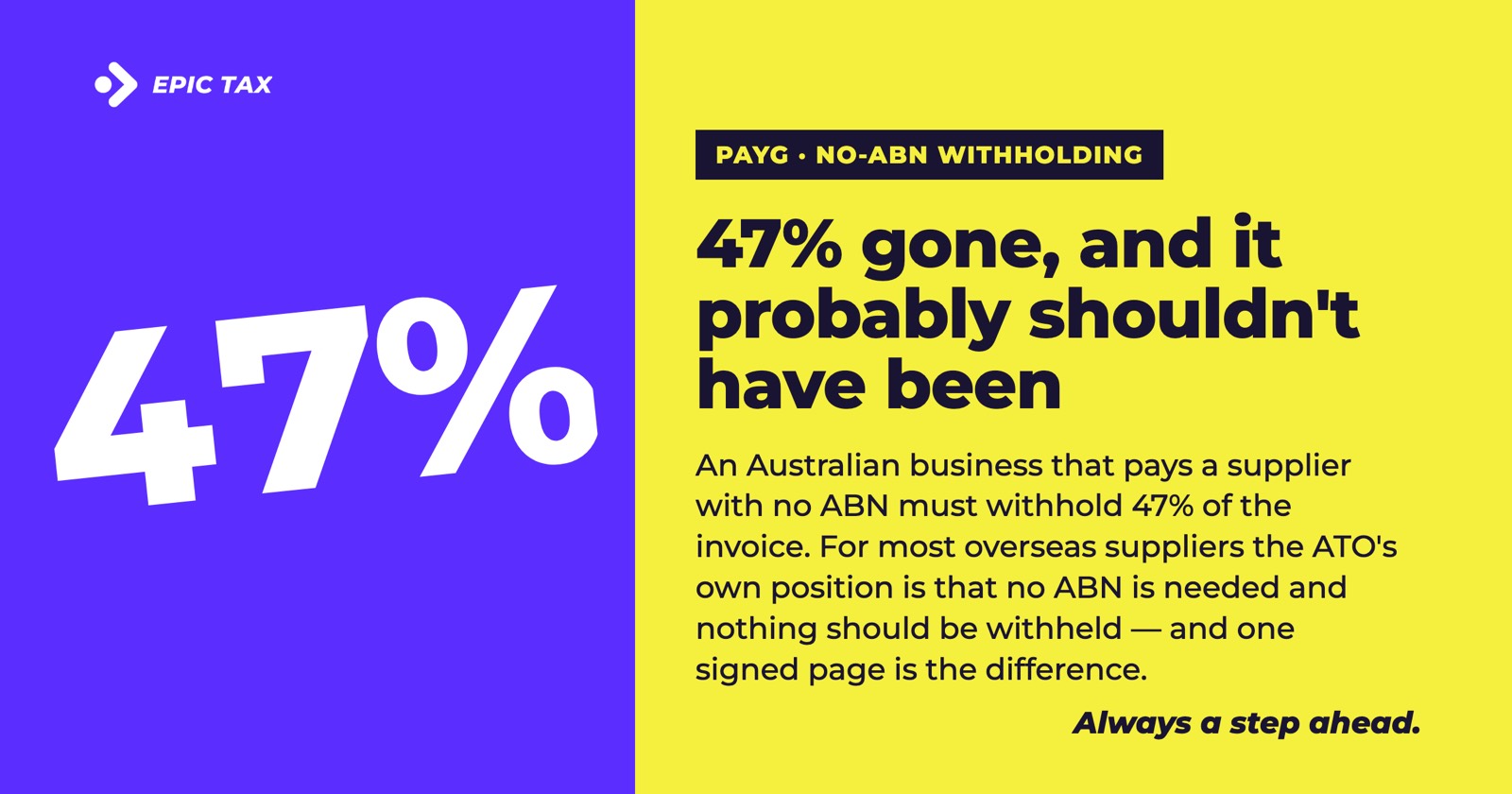
Here is the part that most overseas suppliers never find out: it is not a tax on you, and in a large share of cases it should not have been withheld at all.
| No-ABN withholding in one line | |
|---|---|
| What it is | PAYG withholding where a supplier doesn’t quote an ABN — the payer sends it to the ATO |
| The rate | 47% of the invoice amount, from 1 July 2017 |
| The base | The whole payment for the supply — not your margin, not the GST-exclusive figure |
| When it starts | Payments of more than A$75 for the supply, excluding GST |
| Is it a final tax? | No. It’s a credit against your Australian income tax, claimed by lodging a return |
| If you’re overseas | Generally not required — the ATO says foreign resident suppliers don’t need to quote an ABN unless carrying on an enterprise in Australia |
| What prevents it | Quoting an ABN, or a signed Statement by a supplier where you’re genuinely not entitled to one |
| The trap | Stock in an Australian warehouse means you are entitled to an ABN — you can’t sign the statement |
(General information for FY 2026–27, not tax advice for your circumstances. Every rule below was checked on 25 September 2026 against ato.gov.au — the Withholding from suppliers pages, the Statement by a supplier form page, the PAYG withholding activity statement labels, and the foreign resident withholding rate page — and against abr.gov.au on ABN entitlement.)
1. What is no-ABN withholding, and why did 47% disappear from the payment?
Where an Australian business pays for goods or services and the supplier hasn’t quoted an ABN, the payer must withhold 47% and send it to the ATO. The ATO’s wording is direct: “Where you make payments to suppliers who do not quote their ABN to you, you must withhold 47% (from 1 July 2017) of the invoice amount and pay this to us.” It bites once the total payment for the supply is more than A$75 excluding GST.
Three things about that sentence are worth slowing down for.
The base is the invoice, not the profit. Income tax takes a share of what you earn. This takes 47% of what you are paid. On a A$8,000 invoice with A$6,000 of costs behind it, the withholding is A$3,760 — more than the entire margin. That is why it feels catastrophic the first time it happens, and why it is worth preventing rather than recovering.
It is not a final tax. The amount sits with the ATO as a credit against the supplier’s Australian income tax. If your actual Australian tax liability on that work is nil — which, for a genuinely offshore supplier, it often is — the full A$3,760 is recoverable. But it comes back through an Australian income tax return, not through a phone call to the customer. No return, no money.
Quoting has a deadline. A supplier must quote the ABN by the time the payment is made. An ABN produced afterwards does not unwind the withholding. If you have applied for an ABN and it hasn’t issued, the payer may agree to hold the payment until it does — but the ATO is explicit that the payer “must not make full payment to the supplier on the understanding that an ABN will be quoted later”.
The ABN doesn’t have to be on the invoice, incidentally. Any document relating to the supply will do, including a record of the ABN being quoted over the phone, or the ABN displayed on your website and recorded by the payer with the transaction.
On the payer’s side the mechanics are: register for PAYG withholding, report the amount at label W4 — Amounts withheld where no ABN is quoted on the activity statement, give the supplier a PAYG payment summary – withholding where ABN not quoted when paying the net amount, and lodge the annual report. If you agree to be paid in goods or services instead of money, withholding still applies. The governing ruling is TR 2002/9.
2. When does the payer not have to withhold?
Below A$75 excluding GST, nothing is withheld. Above it, there are six documented exceptions — and the payer must be able to show which one applied.
The A$75 line
When the payment for the full supply is A$75 or less excluding GST, the payer doesn’t need an invoice with an ABN, doesn’t need a tax invoice, and doesn’t withhold.
It cannot be gamed by slicing. The ATO’s own examples: a painter invoices A$150 for a shop sign and has no ABN — the buyer “cannot turn this into two $75 transactions and avoid withholding”. But a florist delivering A$40 of flowers weekly is making separate transactions, and no withholding is required on any of them.
The six exceptions
| Exception | What it covers |
|---|---|
| Not a business transaction | The supplier is an individual not in business as a partnership, company or trust; the supply is private or domestic for them; or it’s part of a hobby or private recreational pursuit |
| Exempt income | The supplier’s income is exempt — religious institutions, schools and other public educational institutions, community service organisations, public and non-profit private hospitals, charities |
| No enterprise | The supplier isn’t carrying on an enterprise and doesn’t need, or isn’t entitled to, an ABN |
| Under 18 | The supplier is an individual under 18 and payments are A$350 or less each week |
| Supplied through an agent | The agent quoted their ABN on an invoice or another document relating to the supply |
| Wholly input taxed | The goods or services supplied are wholly input taxed under GST |
The “not a business transaction” exception has a limit worth knowing: if the payer’s business is a partnership, company or trust and the supply is made through that business, it doesn’t apply.
What the payer carries
Two obligations sit on the Australian business, and they explain behaviour that suppliers often read as obstruction:
- Records. “You must have sufficient records to show the reason for not withholding. This includes keeping any statement you receive for 5 years.”
- Penalty. Pay the invoice gross with no ABN and no documented exception, and the payer “may have to pay a penalty equal to the amount they should have withheld”. On our A$8,000 invoice that is a A$3,760 penalty — paid by the customer, for your missing ABN.
There’s a GST sting for them as well: “As you can’t claim the GST input tax credit for payments you have withheld from, you should keep records of these transactions separate from other payment records.”
So when an Australian customer’s accounts team refuses to release your payment until the ABN question is settled, they are not being difficult. They are avoiding a penalty equal to the amount in dispute.
3. What is the “Statement by a supplier” form, and can you use it?
It is a free ATO form a supplier signs to tell the payer why no ABN is being quoted, so the payer can justify not withholding. It is the single cheapest fix in this whole area — and it has a hard limit that catches people out.
Who can sign it
The ATO lists the grounds. A supplier can use the form where:
- they are an individual and the supply is private or domestic, or made as part of a hobby or private recreational pursuit;
- they are an individual or a partnership without a reasonable expectation of profit or gain; or
- they are not entitled to an ABN because they are not carrying on an enterprise in Australia.
That third ground is the one that matters for overseas suppliers, and section 4 is about it.
Who can’t
The bar is stated just as plainly: a supplier can’t use the form where “they are entitled to an ABN for the relevant activity”. The ATO spells it out — “If the supplier is operating a business or is entitled to register for an ABN, they cannot use the Statement by a supplier.”
Being entitled to an ABN and choosing not to get one is not a ground for anything. It is simply a supply from which 47% will be withheld.
How it works in practice
The statement doesn’t have to be the ATO’s PDF. A payer may accept a written statement from the supplier containing the same information, and it can sit on the invoice itself rather than travel as a separate document — though if it is separate, the payer needs to be able to link it to the transaction records.
Two protections run in opposite directions. The payer is protected: if the ATO reviews the position and finds the statement was incorrect, “payers won’t be penalised if we believe it was reasonable for them to rely on the supplier’s signed statement”. And the payer is obliged: “If the payer has reasonable grounds to believe that the statement the supplier makes is false or misleading, they are required to withhold 47% (from 1 July 2017) from the total payment for the supply.”
Which means a statement signed on shaky grounds doesn’t just fail — it fails at the moment the payer notices, with the withholding reinstated and the relationship damaged.
4. If you’re an overseas supplier, does any of this apply to you?
Usually not — and this is the part worth reading twice. The ATO’s published position is that “foreign resident suppliers generally do not need to provide you with an ABN unless they are carrying on an enterprise in Australia which includes an agent or a branch office in Australia.”
The same guidance covers online ordering directly. Where a supplier “is not carrying on an enterprise in Australia, they will not need to quote an ABN and you will not need to withhold from payments you make to them”. Where the website URL doesn’t identify the supplier as having an Australian connection, the supplier may not have a permanent establishment in Australia, “so you won’t need to withhold” — and the ATO adds that the payer “should retain a record of the reason for not withholding”.
The ATO’s worked example is a business buying from overseas: “John orders goods for his business from an overseas business. The supplier doesn’t need an ABN and John does not need to withhold.” The counter-example in the same passage is the one to watch: where the goods are delivered and invoiced by that supplier’s agent in Australia, and the agent doesn’t quote its ABN, John must withhold.
So the dividing line isn’t where you are incorporated, where the money lands, or what currency you invoice in. It is whether you carry on an enterprise in Australia — an agent or a branch office being the ATO’s own examples.
The warehouse trap
Here is where a lot of confident advice goes wrong, and it is the most important paragraph in this article.
Entitlement to an ABN and the no-ABN withholding trigger use different tests. The ABR lists three grounds of entitlement: carrying on or starting an enterprise in Australia; making supplies connected with Australia’s indirect tax zone; or being a Corporations Act company. The withholding guidance turns on the first of those. The second is a separate, wider limb.
An overseas seller holding stock in an Australian warehouse is making supplies connected with Australia. That seller is entitled to an ABN — which means they cannot honestly sign a statement saying they are not entitled to one, even if they are not carrying on an enterprise in Australia in the branch-or-agent sense. The right move there is not the form. It is to get the ABN, quote it, and deal with the GST registration that usually comes with it.
Sign the statement in that situation and you have given your customer a document that becomes false the moment anyone looks at where your stock sits.
What to actually do
If your work is performed entirely offshore and you have no Australian agent or branch:
- Put a line on your invoice stating that you are a non-resident supplier not carrying on an enterprise in Australia and therefore not required to quote an ABN.
- Offer a signed Statement by a supplier on that ground — most Australian accounts departments will ask for it, and having it ready removes a fortnight of email.
- Keep your own copy. Your customer must keep theirs for five years.
If your stock sits in Australia, or you have an Australian agent or branch, stop and get the ABN sorted instead. The 47% is the smaller of the two problems you have.
5. How is this different from Australia’s non-resident withholding tax?
They share the word “withholding” and nothing else. Non-resident withholding tax applies to specific kinds of investment income at much lower rates, and a tax treaty can reduce it. No-ABN withholding applies to ordinary trade invoices at 47%, treaties don’t touch it, and quoting an ABN switches it off entirely.
| No-ABN withholding | Foreign resident withholding tax | |
|---|---|---|
| What triggers it | Any supply of goods or services to an Australian business without an ABN quoted | Paying particular income to a foreign resident |
| What income | Ordinary trade invoices | Interest, dividends, royalties |
| Rate | 47% of the payment | 10% interest; 30% unfranked dividends and royalties |
| Treaty relief | None — it isn’t a tax on income | Yes: “unless a lower rate is specified in the relevant treaty” |
| Final or creditable | Creditable — recovered through an Australian return | Generally final for these income types |
| How to prevent it | Quote an ABN, or sign a valid Statement by a supplier | Nothing to prevent; treaty rates reduce it |
If you are being paid for design work, software development, consulting, manufacturing, freight or goods, you are in the left column. The right column is for a different conversation — licensing your brand or software to an Australian entity, lending to one, or holding shares in one. Sellers who license their product and invoice for services can be in both, on different lines of the same relationship.
One practical consequence: because no-ABN withholding is creditable rather than final, an overseas supplier who has had it withheld across a year of invoices has a genuine asset sitting at the ATO. It’s recoverable — but only by lodging.
Where it’s worth getting help
Most of this you can handle yourself. The Statement by a supplier is a free form, and a supplier who genuinely isn’t carrying on an enterprise in Australia can sign it, send it, and be paid in full. If that’s your situation, do exactly that and you never need to think about this again.
The judgment calls are where it gets expensive:
- Which side of the line are you actually on? An Australian agent, a local warehouse, a contractor who signs on your behalf — each of these can move you across it, and the ATO’s test is about your arrangements rather than your incorporation.
- Should you sign, or should you register? Signing a statement you weren’t entitled to sign fails the moment the payer has reason to doubt it. Registering for an ABN you didn’t need brings lodgment obligations you also didn’t need.
- Can you get back what’s already been withheld? Amounts withheld across a year of invoices come back through an Australian income tax return — one that has to be prepared, with the payment summaries to support it.
- Is your customer about to withhold again next quarter? Fixing the invoice template is worth more than recovering one payment.
That’s the difference between doing it and doing it right the first time: a supplier who signs the wrong form is in a worse position than one who quoted nothing at all, because now the customer has a document they’ll be asked about.
If you’d like that looked at properly, our initial assessment form scopes it in about twelve questions — what you supply, where the work is done, and where anything you own sits in Australia — without needing a meeting.
FY 2026–27. General information, not tax advice for your circumstances. Whether withholding applies to a particular payment turns on your actual arrangements and on the payer’s assessment of them. Rates and rules quoted are the published ATO and ABR settings as at 25 September 2026; the A$75,000 GST registration turnover threshold is not indexed — confirm the current figure before relying on it.
Does this apply to you?
Book a free consultation — your situation, your options, and a fixed-fee quote within one business day.