
The US–Australia Tax Treaty for Sellers: What It Protects, What It Doesn't (2026)
Part of the guide: Staying compliant · United States
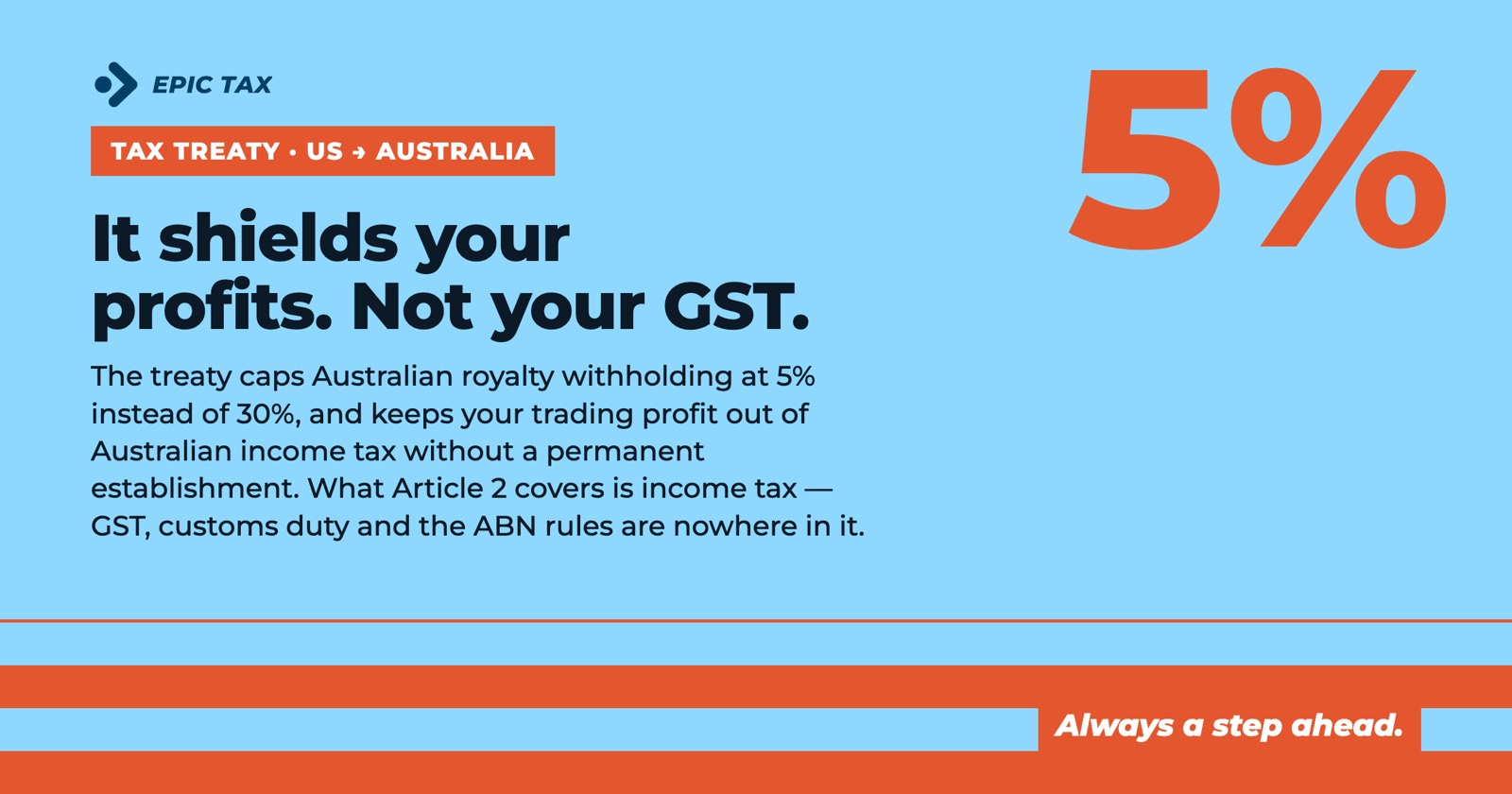
There are two ways to get the US–Australia tax treaty wrong, and they cost about the same.
The first is not claiming it: letting an Australian payer withhold 30% from a royalty stream when the treaty caps it at 5%. On A$200,000 a year that is A$50,000 left behind.
The second is claiming too much from it: reading Article 7, concluding that Australia can’t tax you, and then discovering that the GST bill on your Australian warehouse sales was never anything to do with the treaty in the first place.
This article is about both halves.
| The treaty in one line | |
|---|---|
| What it is | Convention signed 6 August 1982, amended by a Protocol in force 13 May 2003 |
| Taxes covered (Art 2) | Australian income tax, the tax on capital gains, petroleum resource rent tax |
| Not covered | GST, customs duty, the ABN regime, no-ABN withholding, state taxes |
| Business profits (Art 7) | Taxable only in the US unless you have a permanent establishment here |
| Warehouses (Art 5(3)) | Storage, display and delivery of your own goods is not a permanent establishment |
| Royalties (Art 12) | 5% — against a 30% domestic rate |
| Interest (Art 11) | 10% |
| Dividends (Art 10) | 15%, or 5% on a 10%+ corporate holding, or nil on an 80%+ holding |
| The catch | All of it is claimed, not automatic |
(General information for FY 2026–27, not tax advice for your circumstances. The treaty text below was read on 28 September 2026 from the published Convention; the Protocol changes from the Australian Explanatory Memorandum to the International Tax Agreements Amendment Bill (No. 1) 2002; the dates from the Treasury income tax treaties table. We are Australian tax agents — the US side of any of this is outside our scope and outside this article.)
1. What is the Australia–US tax treaty, and what does it actually cover?
It is the Convention between Australia and the United States for the Avoidance of Double Taxation and the Prevention of Fiscal Evasion with respect to Taxes on Income, signed on 6 August 1982 and in force since 31 October 1983, as amended by a Protocol signed on 27 September 2001 and in force from 13 May 2003. Article 2 lists what it applies to: Australian income tax, the tax on capital gains, and petroleum resource rent tax.
A tax treaty does three jobs. It allocates taxing rights between the two countries so the same income isn’t taxed twice at full rates. It caps what the source country may charge on certain payments — dividends, interest, royalties. And it provides a mechanism (Article 22) for the residence country to credit tax paid in the other.
What it does not do is anything outside the taxes named in Article 2. The original text reads:
in Australia; the Australian income tax, including the additional tax upon the undistributed amount of the distributable income of a private company.
The Protocol replaced that paragraph. In the Explanatory Memorandum’s words, it “deletes the undistributed profits tax and includes specific references to Australias tax on capital gains and petroleum resource rent tax”. The EM adds that “the Convention currently does not apply to taxes on capital gains” and the new reference “is intended to clarify that capital gains are to be covered by the Convention following the Protocol”.
Read that list again and notice what has never been on it: GST. Australia’s GST commenced in 2000, seventeen years after the Convention entered into force, and neither the original text nor the 2001 Protocol brought it in. Customs duty isn’t there either. Nor are state taxes. Section 5 comes back to this, because it is where most US sellers actually have an Australian obligation.
One structural note before the substance: Article 1 (Personal Scope) contains the US “savings clause”, which lets the United States tax its own citizens and residents largely as if the treaty didn’t exist, and which the Protocol extended to former long-term residents. That is a US-side concern, and we leave it there.
2. What does it protect a seller from?
Article 7 is the most valuable sentence in the document for a trading business, and it is worth quoting exactly:
The business profits of an enterprise of one of the Contracting States shall be taxable only in that State unless the enterprise carries on business in the other Contracting State through a permanent establishment situated therein. If the enterprise carries on business as aforesaid, the business profits of the enterprise may be taxed in the other State but only so much of them as is attributable to that permanent establishment.
So the question for a US seller is never “do I make sales in Australia”. It is “do I have a permanent establishment in Australia” — and if the answer is no, Australia has no claim on the trading profit at all.
What counts as a permanent establishment
Article 5(1) defines it as a fixed place of business through which the business of an enterprise is wholly or partly carried on. Article 5(2) says the term “shall include especially” a place of management, a branch, an office, a factory, a workshop, sites of natural-resource extraction, an agricultural, pastoral or forestry property, a building or installation project lasting more than nine months, and certain rigs or ships used for at least six months in any twenty-four.
None of that describes a typical online seller.
The warehouse question, answered in the treaty’s own words
This is the paragraph US sellers most need and least often read. Article 5(3) provides that an enterprise “shall not be regarded as having a permanent establishment solely as a result of one or more of the following”:
(a) the use of facilities for the purpose of storage, display or delivery of goods or merchandise belonging to the enterprise;
(b) the maintenance of a stock of goods or merchandise belonging to the enterprise for the purpose of storage, display or delivery;
It continues: stock held for processing by another enterprise (c); a fixed place kept for purchasing goods or collecting information (d); a fixed place for activities “which have a preparatory or auxiliary character, such as advertising or scientific research” (e); short building sites (f); and short-duration rigs or ships (g).
Paragraphs (a) and (b) are the standard third-party-logistics and marketplace-fulfilment pattern, described in the treaty as expressly not a permanent establishment.
Where it does bite — Article 5(4)
Do not stop reading at paragraph (3). Article 5(4) deems a permanent establishment to exist where the enterprise:
- carries on business through a person, other than an independent agent, “who has authority to conclude contracts on behalf of that enterprise and habitually exercises that authority” in Australia;
- maintains substantial equipment for rental or other purposes in Australia for more than 12 months;
- engages in supervisory activities for more than nine months in any twenty-four on a construction project; or
- has goods purchased or produced in Australia that are then subjected to substantial processing in Australia by a related enterprise.
The first of those is the live risk for a growing seller: a local contractor, country manager or sales agent who signs on your behalf can create the permanent establishment that a warehouse full of your stock does not. Article 5(5) preserves the position where you sell through “a broker, general commission agent, or any other agent of independent status… acting in the ordinary course of his business”. And Article 5(6) confirms that controlling, or being controlled by, an Australian company is not by itself a permanent establishment.
Two more articles round out the protection. Article 9 (Associated Enterprises) is the transfer pricing rule — it allows either country to adjust profits between related parties that don’t deal at arm’s length, which matters if you sell to your own Australian subsidiary. Article 22 (Relief from Double Taxation) is the credit mechanism that stops the same income being taxed twice where both countries do have a claim.
3. What are the withholding tax rates under the treaty?
Royalties 5%, interest 10%, dividends 15% with reductions for substantial corporate holdings. The comparison that matters is Australia’s domestic rate: 30% on royalties and unfranked dividends, 10% on interest.
| Payment | Australian domestic rate | Treaty rate | Article |
|---|---|---|---|
| Royalties | 30% | 5% | Art 12 (as amended) |
| Interest | 10% | 10%, with exemptions for government bodies and financial institutions | Art 11 |
| Dividends, portfolio | 30% unfranked | 15% | Art 10 |
| Dividends, 10%+ corporate holding | 30% unfranked | 5% | Art 10 (as amended) |
| Dividends, 80%+ holding meeting Art 16 | 30% unfranked | Nil | Art 10 (as amended) |
The royalty rate is the one that moves money. As signed in 1982 the cap was 10%; the Explanatory Memorandum records that “the Protocol will reduce the limit on source country taxation of royalties from 10% to 5%”. Against a 30% domestic rate, on A$200,000 of royalties a year:
| Withheld | Received | |
|---|---|---|
| No treaty claim, domestic rate 30% | A$60,000 | A$140,000 |
| Article 12 claimed, 5% | A$10,000 | A$190,000 |
A$50,000 a year — and the ATO’s position on its own domestic rates is that they “apply to all payees unless a lower rate is specified in the relevant treaty”. The lower rate applies, but somebody has to tell the payer who you are. It is claimed, not automatic.
The equipment carve-out most summaries miss
The Protocol did something else to Article 12 that is worth more than the rate cut to some businesses. Payments for the use of industrial, commercial or scientific equipment used to be royalties. They aren’t any more. The Explanatory Memorandum:
The effect of the change to the royalties definition is that the Royalties Article will cease to apply to payments previously treated as equipment royalties, and the Business Profits Article will apply to these payments. The source country will therefore only be able to tax the payments to the extent they are connected with a business carried on through a permanent establishment in that country.
So equipment hire payments are now business profits under Article 7. No permanent establishment means no Australian tax and nothing withheld — not 5%, nothing. This has applied since 1 July 2003.
Running the other way, the Protocol widened the royalty definition for broadcasting: it now covers payments for video or audio disks and other means of image or sound reproduction or transmission for television, radio or other broadcasting, which the EM says was meant to reach satellite and internet broadcasting.
Limitation on Benefits
The Protocol also inserted a new Article 16, which exists “to prevent residents of third countries from using interposed companies or other entities resident in one of the treaty countries to inappropriately access treaty benefits (i.e. treaty shopping)”. A genuine US operating company is not the target. A holding entity placed in the US to reach Australian treaty rates may be. The qualification tests are entity-specific and we’re not setting them out here.
4. Which articles actually matter to a seller?
There are twenty-nine. Most sellers need about ten of them.
| Article | What it does | Why a seller cares |
|---|---|---|
| 1 Personal scope | Who the treaty applies to, plus the US savings clause | Confirms you’re in it; the savings clause is a US-side issue |
| 2 Taxes covered | Australian income tax, CGT, PRRT | The boundary of everything — GST is not here |
| 5 Permanent establishment | Defines the threshold for Australian taxing rights | Warehouses are out (5(3)); agents who sign are in (5(4)) |
| 7 Business profits | Taxable only in the US without a PE | Removes Australian income tax for most sellers |
| 9 Associated enterprises | Arm’s-length adjustment between related parties | Selling to your own Australian subsidiary |
| 10 Dividends | 15% / 5% / nil | Profits repatriated from an Australian subsidiary |
| 11 Interest | 10%, with exemptions | Intra-group loans into Australia |
| 12 Royalties | 5%; equipment payments excluded | Licensing software, brand, content |
| 16 Limitation on benefits | Anti-treaty-shopping | Only if the US entity is a conduit |
| 21 Income not expressly mentioned | Residual income “taxable only in that State” | The catch-all for payments that fit no other article |
| 22 Relief from double taxation | Foreign tax credit | Where both countries do have a claim |
Article 21 is the quiet one. It provides that items of income of a resident of one country that aren’t expressly mentioned elsewhere in the Convention “shall be taxable only in that State” — subject to a source rule in paragraph (2) and a carve-out in paragraph (3) where the income is effectively connected with a permanent establishment. It is the residual category for payments that don’t fit the labelled boxes.
5. What does the treaty NOT protect you from?
Everything that isn’t a tax on income. This is the half that catches US sellers, because the protection in sections 2 and 3 is real enough to feel like a blanket.
| Obligation | Covered by the treaty? |
|---|---|
| Australian income tax on trading profit | Yes — Article 7, no PE, no tax |
| Capital gains tax | Yes — added by the 2001 Protocol |
| Petroleum resource rent tax | Yes — added by the 2001 Protocol |
| GST | No |
| Customs duty and border charges | No |
| ABN registration obligations | No |
| No-ABN withholding at 47% | No |
| State taxes — payroll tax, land tax, stamp duty | No |
GST, which is where the real obligation usually is
Take the same US company from section 2. It ships stock to a Melbourne 3PL and sells to Australian customers online. Article 5(3) means the warehouse is not a permanent establishment; Article 7 means Australia can’t tax the trading profit. Excellent — and completely irrelevant to GST.
Goods located in Australia when they sell are domestic supplies made by the seller. That brings the ordinary GST rules: registration may be required once GST turnover reaches A$75,000, within 21 days of being required, with an ABN needed before you can register at all. The treaty says nothing about any of it, because GST isn’t in Article 2.
It is entirely normal for a US seller to owe no Australian income tax and still be required to register for, charge and remit Australian GST. Those two facts don’t contradict each other; they come from different bodies of law, and only one of them has a treaty over it.
No-ABN withholding, which the treaty also can’t switch off
If an Australian business pays you more than A$75 (excluding GST) for a supply and you haven’t quoted an ABN, it must withhold 47%. That isn’t a tax on your income — it’s a collection mechanism attached to the invoice, so Article 7 doesn’t reach it.
The interaction is worth understanding. Article 7 may well mean you owe no Australian income tax on that payment. The 47% is still withheld, and it comes back only as a credit on an Australian income tax return that you then have to lodge. Our article on no-ABN withholding covers the exceptions, including the position the ATO takes on foreign resident suppliers.
Customs duty and state taxes
Duty is levied under the Customs Tariff, not the income tax law, so no income tax treaty touches it — preferential rates come from trade agreements instead, which is a different instrument entirely. State taxes — payroll tax if you employ people here, land tax, stamp duty — are imposed by the states and sit outside a Commonwealth income tax treaty.
Where it’s worth getting help
If your only Australian connection is a royalty stream and you have no presence here, this is straightforward: establish your US residency with the payer, and the 5% rate under Article 12 applies instead of 30%. Many businesses can handle that themselves once they know the rate exists.
The judgment calls are where the money and the risk sit:
- Are you near a permanent establishment? Article 5(3) protects the warehouse. Article 5(4) is where a business actually crosses the line — usually through someone in Australia with authority to conclude contracts, or through substantial processing of goods by a related party.
- What kind of payment is it? Royalty, equipment payment or business profit changes the rate from 5% to nothing. Since 2003 that classification is worth getting right rather than assuming.
- Has too much already been withheld? Recovering over-withheld amounts is possible, but it runs through a process rather than a request.
- What is your GST position? This is the one the treaty leaves entirely alone, and for sellers holding stock in Australia it is usually the only Australian registration they actually need.
That’s the difference between doing it and doing it right the first time: the seller who reads Article 7, concludes Australia has no claim on them, and files nothing — then finds the GST registration should have started at A$75,000 of turnover two years ago.
If you’d like that looked at properly, our initial assessment form scopes it in about twelve questions — what you’re paid for, who acts for you in Australia, and where your stock sits — without needing a meeting.
FY 2026–27. General information, not tax advice for your circumstances. How the articles apply turns on your actual arrangements, and treaty positions are fact-specific. Treaty text and Protocol changes quoted are from the published Convention and the Australian Explanatory Memorandum to the International Tax Agreements Amendment Bill (No. 1) 2002, read 28 September 2026; the A$75,000 GST registration turnover threshold is not indexed — confirm the current figure. United States tax treatment is outside our scope.
Does this apply to you?
Book a free consultation — your situation, your options, and a fixed-fee quote within one business day.